

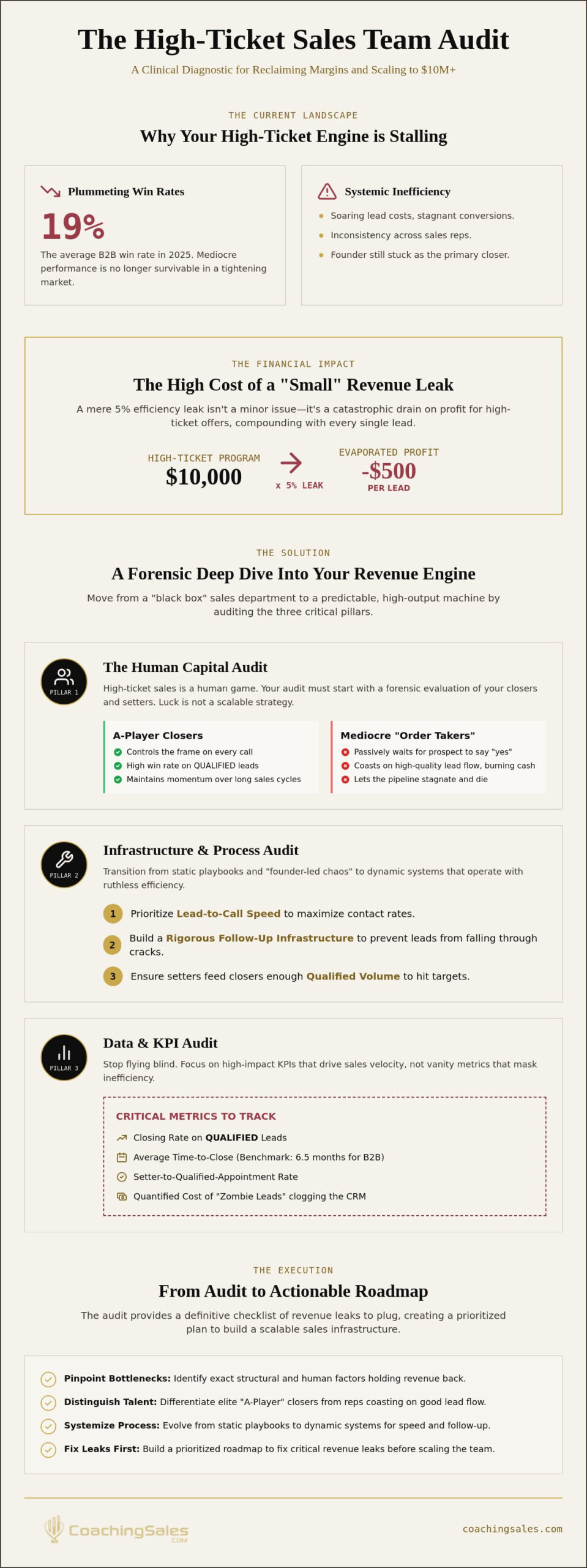
B2B win rates plummeted to just 19% in 2025. If your high-ticket engine feels sluggish, it isn't just your imagination; it's a symptom of systemic inefficiency. A rigorous sales team audit is no longer a “nice-to-have” exercise for your operations team. It is the clinical diagnostic required to stop the bleed and reclaim your margins in a tightening market.
You already know the frustration of soaring lead costs paired with stagnant conversion rates. You see the inconsistency across your closers and feel the weight of still being the primary driver in the sales seat. Without clear visibility into your true KPIs, you're essentially flying blind. This lack of structure is the only thing standing between your current plateau and a $10M+ scale.
This guide exposes the specific bottlenecks currently choking your growth. You'll get a definitive checklist of revenue leaks to plug and a proven roadmap for building a scalable sales infrastructure. We are moving past unproven theories to provide you with actionable steps. It is time to stop guessing and start operating with absolute certainty so you can finally step out of the daily operations for good.
Key Takeaways
- Conduct a clinical sales team audit to pinpoint the exact structural and human bottlenecks holding your revenue back from the $10M mark.
- Distinguish between elite “A-Player” closers and mediocre reps who are simply coasting on high-quality lead flow.
- Transition from static sales playbooks to dynamic systems that prioritize lead-to-call speed and rigorous follow-up infrastructure.
- Identify the high-impact KPIs that actually drive sales velocity rather than getting bogged down in vanity metrics that mask inefficiency.
- Build a prioritized roadmap to fix critical revenue leaks before scaling your team with vetted, high-performance talent.
What is a High-Ticket Sales Team Audit?
A sales team audit is a clinical, systematic diagnostic of your people, your processes, and your performance. It isn't a casual check-in or a “vibes” assessment of your team's energy. It is a forensic deep dive into the machinery of your revenue engine. In a high-ticket environment, the complexity of human psychological triggers and long-form decision cycles makes this audit radically different from a low-ticket ecommerce review. You aren't auditing clicks; you're auditing conviction, rapport, and the execution of fundamental sales principles.
The cost of ignoring these leaks is staggering. If you're selling a $10,000 program and your team has a mere 5% efficiency leak, you aren't just losing a few dollars. You're losing $500 on every single lead interaction. Over a month of high-volume traffic, that “small” gap compounds into hundreds of thousands in evaporated profit. This is the difference between a business that survives and one that scales to $10M+.
Most founders start with “founder-led chaos.” You likely closed the first few million yourself through sheer force of will. But that doesn't scale. An audit is the bridge between you being the primary closer and having an elite infrastructure that functions without you. It turns your sales department from a black box into a predictable, high-output machine.
The ROI of a Rigorous Audit
A precise audit identifies “zombie leads” immediately. These are prospects clogging your CRM and draining your setters' time without any real intent to buy. By quantifying the cost of poor closer performance, you stop guessing why revenue is flat and see exactly who is burning your expensive leads.
- Stop the bleed: Identify specific points where prospects drop off in your high-ticket funnel.
- Maximize capacity: Ensure your setters are feeding your closers enough qualified volume to hit targets.
A sales team audit is a high-stakes revenue-recovery mission designed to reclaim lost margins.
When to Audit Your Sales Engine
You'll know it is time when you hit the “Founder Ceiling.” This happens when you've reached your personal capacity for closing and your team isn't picking up the slack. If your revenue is plateauing despite increasing your lead spend, you have a conversion problem, not a traffic problem. High turnover in your sales roster is another red flag. If your closers keep quitting, your infrastructure is likely broken. Don't wait for the engine to seize; audit it while you still have momentum.
The Human Capital Audit: Vetting Your Closers and Setters
Most business owners audit their tech stack when revenue stalls. They check the CRM, the email sequences, and the landing pages. This is a mistake. High-ticket sales is a human game. If your talent is mediocre, your results will be too. A comprehensive sales team audit must begin with a forensic evaluation of the people holding the phones. You need to know if your closers are truly elite or if they've simply been lucky enough to ride a wave of high-quality lead flow.
Luck is not a strategy for $10M+ scale. As B2B win rates dropped to 19% in 2025, the chasm between “order takers” and “active closers” became impossible to ignore. Order takers wait for the prospect to say yes; they are passive observers of their own commission checks. Active closers lead the prospect through a psychological journey, handling objections before they're even voiced. If your reps aren't controlling the frame on every call, you don't have a sales team; you have a customer service department that costs you ten times more than it should.
Evaluate your sales onboarding process for closers to determine if your new hires are being set up for aggressive ROI. A broken onboarding system is the primary reason why even talented reps fail. If your current roster lacks the necessary edge, it may be time to consider professional sales recruiting to inject vetted, high-performance talent into your engine.
Closer Performance Benchmarks
Stop looking at total revenue as your only metric. It's a vanity number that hides inefficiency. You must audit the closing rate on qualified leads specifically. If a closer has a 40% win rate but only closes the “easy” lay-ups, they're costing you a fortune in wasted ad spend. Track the average time to close within your high-ticket cycles. In 2025, the average B2B sales cycle extended to over 6.5 months. If your reps can't maintain momentum over that duration, your pipeline will eventually stagnate and die.
The Setter Program Efficiency
Your setters are the gatekeepers of your closers' time. Audit your setter-to-closer ratio to ensure your calendar capacity is actually being maximized. If your closers have empty gaps in their day, your setter program is failing. Speed is a human trait, not just a tech setting. According to data from Harvard Business Review, the life of a lead is incredibly short. If your setters aren't engaging prospects within minutes, your show-up rates will plummet. Review the feedback loop between your closers and setters. Are setters over-qualifying and killing volume, or are they under-qualifying and wasting your closers' elite time with “looky-loos”?
Infrastructure and Process Audit: Beyond the Script
Infrastructure is the bone structure of your revenue engine. Without it, even elite talent will eventually fail. A sales team audit that ignores your underlying systems is just a glorified performance review. You can't scale a high-ticket offer to $10M+ on the backs of unguided closers. You need a repeatable, documented machine that ensures every lead receives the same elite experience, regardless of which rep picks up the phone.
Start by scrutinizing your high ticket lead follow up systems. High-ticket leads don't just “go cold”; they evaporate. If your handoff from setter to closer is clunky, or if your automated touchpoints feel like generic spam, you're hemorrhaging ROI. You must also review the transition from founder led sales to ensure your team isn't just mimicking your personality but is actually executing a scalable process. If your closers sound like robots, you have script fatigue. This happens when reps lean on a dusty PDF instead of internalizing the psychology of the sale.
The High-Ticket Sales Playbook Audit
Your sales playbook is the “source of truth” for your entire operation. It shouldn't be a static document; it's a living asset that must evolve with the market. Does your current playbook address the hyper-skeptical 2026 buyer? It needs to include a clear Standard Operating Procedure (SOP) for every stage of the pipeline, from the initial discovery call to the final contract signature. An academic study on sales training suggests that structured, research-based training frameworks are significantly more effective than “trial and error” approaches. If your playbook doesn't cover specific objection handling for high-ticket price points, your team is flying blind. Building custom sales playbooks that act as the operational OS for your revenue engine is the only way to ensure every closer executes with the same precision you would.
CRM and Tooling Optimization
Audit your lead routing immediately. Are your “A-Player” closers getting the highest-intent leads, or is your CRM distributing them randomly? This is a massive revenue leak. You should also check for CRM friction. If your reps spend more time typing notes than talking to prospects, your tech stack is a liability, not an asset. Evaluate the integration between your marketing data and sales calls. Your closers should know exactly which ad or piece of content a prospect consumed before the call starts. This level of visibility turns a cold pitch into a strategic consultation.
Data and KPI Audit: Tracking the Numbers That Matter
Total revenue is a vanity metric. It tells you what happened last month, but it won't tell you why you're going to miss your targets next quarter. A precision sales team audit demands that you look at the granular, leading indicators that actually drive sales velocity. If you can't see the leaks in your data, you can't plug them. Scaling to $10M+ requires moving past “gut feelings” and into the realm of absolute mathematical certainty.
Speed-to-lead is your most critical operational metric. High-ticket prospects lose interest in minutes, not hours. If your team takes half a day to respond to an inquiry, you're burning your marketing budget. You must also audit your “No-Show” rates with clinical detachment. Are prospects failing to show because of poor setter qualifying, or because your pre-call indoctrination sequence is non-existent? Identify the specific reasons behind every missed call to stop the profit bleed. Review your CPA vs. LTV ratio regularly. If your acquisition cost is creeping toward 30% of your lifetime value, your scaling efforts will eventually hit a wall of diminishing returns.
If your data shows a volume problem rather than a closing problem, it is time to install a proven Setter Program to maximize your calendar capacity.
The Non-Negotiable High-Ticket KPI Checklist
Focus on the numbers that correlate directly with growth. Your “Qualified Lead-to-Close” percentage is the only closing metric that matters; closing “lay-ups” doesn't count. You must also track the “Setter-to-Closer” handoff conversion rate. This is where most high-ticket engines fail. Finally, monitor your Average Deal Size (ADS) trends over the last 12 months. If your ADS is dropping while your lead costs are rising, your business model is under threat. A healthy pipeline coverage ratio should remain between 3:1 and 4:1 to ensure your targets stay within reach.
Pipeline Health and Velocity
Stalled deals are the “zombies” of your CRM. If a deal hasn't moved in 30 days, it is likely dead. Audit your sales cycle length to ensure it isn't bloating without reason. While the average B2B sales cycle extended to over 6.5 months in 2025, elite teams find ways to compress this through better education and urgency. Your goal is forecasting accuracy. You should be able to predict next month's revenue with 90% certainty. If you can't, your sales team audit isn't deep enough yet. Use these numbers to build a roadmap that removes the guesswork from your daily operations.
Executing the Fix: From Audit to $10M+ Scale
An audit without execution is just expensive trivia. You've identified the leaks; now you must plug them with clinical precision. High-performers don't wait for “the right time” to fix structural issues. Prioritize your findings by impact. Fix the “bleeding” immediately. These are the leaks costing you immediate cash, such as slow lead response times or broken handoff protocols. Only after the revenue is stabilized should you worry about the “bruises,” which are minor process refinements like email template tweaks. This is how you reclaim your time and hit that $10M+ trajectory.
Your 90-day execution roadmap starts now. In the first 30 days, eliminate the structural friction in your CRM and follow-up sequences identified in your sales team audit. By day 60, your talent roster must be optimized. By day 90, your new sales coaching rhythm should be second nature. This roadmap isn't a suggestion; it is the blueprint for your transition from founder-led chaos to an institutionalized sales machine. If your current team cannot meet these standards, you face a choice: spend months training them or move directly to recruiting elite closers who are already battle-tested in high-ticket environments.
Plugging the Talent Gap
Culture is your most valuable asset. A “B-Player” closer who hits targets but poisons the room is a long-term liability. Cut them quickly. If you need immediate results without the hiring lag or the burden of training, done for you sales closers provide a plug-and-play solution to jumpstart growth. Always build a bench of talent before the need becomes a crisis. This ensures you never settle for mediocrity out of desperation. Elite teams are built on anticipation, not reaction.
Establishing a Culture of Accountability
Accountability is the byproduct of clear, enforced standards. Set non-negotiable requirements for CRM hygiene and daily call reviews. A feedback loop that actually improves performance requires radical honesty. If a rep misses a standard, there must be a consequence. This isn't about being difficult; it's about being professional. A sales team audit is a recurring 6-month necessity to ensure your engine remains optimized for the shifting 2026 marketplace. Constant vigilance is the price of $10M+ scale.
Reclaiming Your Revenue Engine for $10M+ Scale
You've identified the gaps between your current operations and a scalable $10M+ infrastructure. You now know that elite talent only performs when backed by a custom sales playbook architecture and clinical CRM hygiene. Moving beyond founder-led sales requires a decisive shift from gut feelings to actionable, granular KPIs that drive sales velocity. Every day you wait is a day your revenue continues to leak into the pockets of your competitors.
Conducting a rigorous sales team audit is the only way to ensure your engine is built for the hyper-competitive 2026 market. It's the difference between a business that plateaus and one that dominates. As specialists in $10M+ scaling, we provide the vetted high-ticket talent and custom playbook architecture required to stabilize your growth and remove you from the daily sales seat for good.
Stop guessing where your money is going and start operating with absolute mathematical certainty. Expose your revenue leaks with a battle-tested sales team audit from Coaching Sales. The roadmap is clear. Your next level of scale is waiting for you to take the first step. You've got the vision; now build the machine to match it.
Frequently Asked Questions
How often should a high-ticket business perform a sales team audit?
A high-ticket business should conduct a formal sales team audit every six months. The market landscape in 2026 evolves too quickly for annual reviews to be effective. Biannual audits ensure your infrastructure stays ahead of shifting buyer psychology and rising lead costs. If you're scaling toward $10M+, this rhythm prevents small inefficiencies from compounding into million-dollar revenue leaks.
What is the difference between a sales audit and a performance review?
A sales audit evaluates the entire revenue machine, while a performance review focuses on the individual rep. The audit looks at your playbooks, lead routing, and CRM hygiene to ensure the system itself isn't broken. A performance review assesses whether a specific closer is executing that system correctly. You can't fix a talent problem with a better process, and you can't fix a broken process by hiring better talent.
What are the biggest “red flags” to look for during an audit?
The most dangerous red flag is stagnant revenue paired with increasing lead spend. This indicates a massive conversion leak in your middle-of-funnel operations. Other warnings include high rep turnover, a “founder-led” ceiling where the owner is still closing, and a significant drop in win rates. In 2025, B2B win rates fell to 19%. If yours is lower without a clear reason, your engine is failing.
Can I perform a sales team audit myself or do I need an outside firm?
You can perform an initial audit internally using your CRM data, but an outside firm provides the objectivity required for $10M+ scale. Internal audits often suffer from “founder bias” where systemic flaws are overlooked as “just the way we do things.” External experts bring a battle-tested perspective and can identify bottlenecks that you are simply too close to see.
How long does a comprehensive sales team audit typically take?
A comprehensive audit typically takes between two and four weeks to complete. This isn't a surface-level glance at a spreadsheet. It involves deep-diving into months of CRM data, reviewing hours of call recordings, and mapping out every stage of your setter-to-closer handoff. Rushing this process leads to shallow insights that won't actually move the needle on your revenue.
Which sales KPIs are the most important for high-ticket scaling?
Focus on sales velocity, speed-to-lead, and the qualified lead-to-close rate. While total revenue is a vanity metric, sales velocity tells you how quickly money is moving through your pipeline. Speed-to-lead is critical because high-ticket prospects lose interest in minutes. You must also track the setter-to-closer handoff conversion to ensure your calendar capacity isn't being wasted on unqualified leads.
How do I audit my sales team without hurting morale?
Frame the sales team audit as an investment in the team's ability to earn higher commissions. It isn't a witch hunt; it's a mission to remove the friction that prevents your closers from hitting their targets. When you position the audit as a way to provide them with better leads, faster follow-up, and superior playbooks, your high-performers will welcome the optimization.
What is the first thing I should fix after an audit?
Fix your speed-to-lead immediately. It is the lowest-hanging fruit with the most significant impact on your bottom line. If your setters aren't engaging leads within five minutes, you're effectively burning your marketing budget. Once the “bleeding” of lost leads is stopped, you can move on to more complex fixes like sales playbook architecture and closer retraining.