

The cost to replace a single sales representative has climbed as high as $200,000 in 2026. If you're still relying on a “sink or swim” approach, you aren't just losing talent; you're actively burning your most expensive high-ticket leads. You need a sales onboarding process for closers that functions like a precision-engineered revenue machine rather than a hopeful experiment. It's the difference between a typical six-month ramp-up and a thirty-day sprint to full productivity.
You've likely felt the sting of watching a new hire fumble a five-figure deal while they “find their rhythm.” It's a drain on your cash flow and a massive bottleneck for your scaling efforts. This guide provides the exact roadmap to integrate elite closers into your business with surgical precision. Learn how to implement a standardized, repeatable system that drives full quota attainment within 30 days. We're breaking down the high-performance phases that allow you to maximize ROI and finally step out of the sales seat for good.
Key Takeaways
- Eliminate the traditional 90-day ramp-up trap and drive your team to full quota attainment within a 30-day velocity window.
- Build a high-performance sales playbook that acts as the central nervous system of your business, transferring founder-level conviction to every new hire.
- Master a precision-engineered sales onboarding process for closers to stop burning expensive high-ticket leads and start maximizing ROI from day one.
- Secure the high-risk transition from founder-led sales to a scalable team by documenting intuitive market knowledge into a repeatable system.
- Recognize that elite talent is only half the battle; long-term success requires plugging vetted closers into a proven, “done-for-you” sales infrastructure.
Why Generic Sales Onboarding Fails High-Ticket Closers
Most businesses treat onboarding as a clerical formality. They hand a new hire a PDF, show them the CRM, and hope for the best. This “sink or swim” mentality is a recipe for disaster in the high-ticket space. A world-class sales onboarding process for closers isn't about teaching someone how to sell. If you hired correctly, they already possess that skill set. It's about transferring founder-level conviction and providing the specific system context they need to win immediately.
The traditional 90-day ramp-up is a death sentence for high-growth firms. Research indicates the average B2B sales rep takes 3 to 6 months to reach full productivity, but in a high-ticket environment, that delay kills cash flow. You're paying for leads today. You're paying for overhead today. If your closer isn't hitting numbers in 30 days, your “ramp-up” period is actually a “burn-down” of your profit margins. You aren't just losing time; you're losing the compounding interest of early revenue.
Integrating closers is a middle-of-funnel and bottom-of-funnel operation. You aren't teaching them how to open a conversation; you're teaching them how to handle the specific objections that arise at the finish line of your unique sales cycle. When elite closers quit, it's rarely because they can't close. It's because they were forced to “figure it out as they go” without a clear roadmap. This lack of structure creates inconsistent performance and damages your brand's reputation.
The High-Ticket Difference
High-ticket closers operate on a different psychological plane than SaaS SDRs. When you're asking a prospect for a $10,000 investment, scripts aren't enough. The closer must possess absolute conviction in the offer's transformation. This requires deep immersion into the product and the market's specific pain points. You can't afford a “learning curve” on live calls. Every burnt lead is a wasted investment. Effective sales management principles dictate that you must protect your lead flow by ensuring closers are battle-ready before they ever pick up the phone.
The Cost of Inefficient Onboarding
The numbers are staggering. Replacing a single sales representative can cost between $100,000 and $200,000. A slow sales onboarding process for closers doesn't just cost you the new hire's salary; it costs you the revenue they didn't generate. This inefficiency leads to lead-source burnout, where your marketing team stops trusting the sales team to convert their hard-earned traffic. If your team sees new hires failing to hit numbers early, it erodes the culture of winning. A precision-engineered system prevents this churn and ensures your revenue machine stays optimized for scale.
Building the Infrastructure: The Pre-Onboarding Checklist
You wouldn't put a Formula 1 driver behind the wheel of a minivan and expect a podium finish. Hiring an elite closer without a built-out infrastructure is just as foolish. Your sales onboarding process for closers actually starts weeks before their first day. It requires a hard look at your internal systems. If your CRM is a mess or your lead tracking relies on “best guesses,” you're setting your new hire up for an expensive failure. Success in high-ticket sales is a game of margins. You need a precision-engineered environment where the closer can simply plug in and produce.
The sales playbook serves as the central nervous system of this environment. It isn't a dusty manual or a theoretical guide. It's a living, actionable document that dictates every move from the initial lead capture to the final signature. While many competitors push complex LMS portals, we know those are often where good information goes to die. Elite closers don't need a portal; they need a roadmap. They need to know exactly how your specific machine converts a stranger into a high-value client.
The Essential Sales Playbook
Your playbook must define the “Golden Script” with absolute clarity. This isn't about robotic recitation; it's about providing the structural pillars of a winning conversation. It should include situational rebuttals for every common objection your market throws at you. When a prospect says “I need to talk to my spouse,” your closer shouldn't have to pause. They should have the proven response ready to deploy. If you haven't started building a custom sales playbook yet, your onboarding will never reach peak efficiency. You're essentially asking your new hire to build the plane while they're flying it.
CRM and Tech Stack Readiness
Elite closers want to spend their time on the phone, not doing data entry. Your CRM architecture must be bulletproof to allow this. Automate the administrative “boring stuff” so your team can focus on the human element of high-ticket sales. This includes setting up call recording software for rapid feedback cycles and daily reviews. You also need clear lead distribution rules. During the initial phases of the sales onboarding process for closers, protect your highest-value leads. Give the new hire enough volume to practice without risking your most lucrative opportunities. Establishing a tight feedback loop ensures that every call is a learning opportunity. If you want to scale without the usual chaos, investing in professional Sales Playbooks can bridge the gap between “figuring it out” and total market dominance.
The Critical Handoff: Transitioning from Founder-Led Sales
The handoff from founder to closer is the single most dangerous moment in scaling. Why? Because most founders fail to realize that their sales success is built on a decade of unwritten market intuition. You can't just hand over a CRM login and hope for magic. This phase of the sales onboarding process for closers requires a deliberate, surgical extraction of your “secret sauce.” You aren't looking for a clone of yourself. You're looking for an ROI-driven operator who can execute your system at scale without you in the room. Understanding the full scope of what it takes to transition from founder led sales to a scalable revenue engine is essential before you hand off your first live call.
How do you document what you “just know” about your market? It starts with acknowledging that your conviction is your greatest asset. If your closer doesn't believe in the offer as much as you do, they'll fold at the first sign of resistance. You must bridge this gap by creating training assets that go beyond simple scripts. You're transferring the soul of the business, not just a set of instructions.
Documenting Your Secret Sauce
Externalize your conviction immediately. Elite closers need to understand the “Why” behind the offer just as much as the “What.” Record yourself explaining the specific, high-stakes problems your business solves. Why did you start this company? What specific pain points keep your clients up at night? If you don't provide this context, the closer is just a talking head.
Define your Ideal Client Profile (ICP) in a single, punchy sentence. If you can't explain who you serve with surgical precision, your closer will burn through expensive leads trying to find the “right” fit. These recordings and definitions aren't just tutorials. They're the psychological fuel your closer needs to maintain certainty during a high-ticket pitch. If they don't know who the offer is for, they can't close with authority.
The Gradual Release Model
Don't throw a new hire into the deep end and expect them to swim. Use a structured, three-phase transition to protect your lead flow and your sanity. This is a non-negotiable part of a professional sales onboarding process for closers.
- Phase 1: Pure Shadowing. The closer shadows the founder for 3 to 5 live calls. They don't speak. Their only job is to map the emotional arc of the conversation and note how you handle specific, recurring objections.
- Phase 2: Reverse Shadowing. You shadow the closer for the next 3 to 5 calls. This is the “safe to fail” zone. You're there as a safety net, but they take the lead. Provide a rigorous, no-nonsense debrief immediately after each call while the details are fresh.
- Phase 3: Solo Execution with Daily Reviews. The closer flies solo but remains under a microscope. Implement a mandatory daily call review process. Catch bad habits before they become permanent fixtures in your sales cycle.
This methodical release ensures the transition remains focused on ROI rather than hope. It allows you to transition from the “Sales Seat” to the “Leader Seat” without watching your conversion rates plummet. Success here is about building a repeatable revenue machine, not a personality-driven cult. If you don't manage this handoff with precision, you'll find yourself pulled back into the sales seat within weeks.
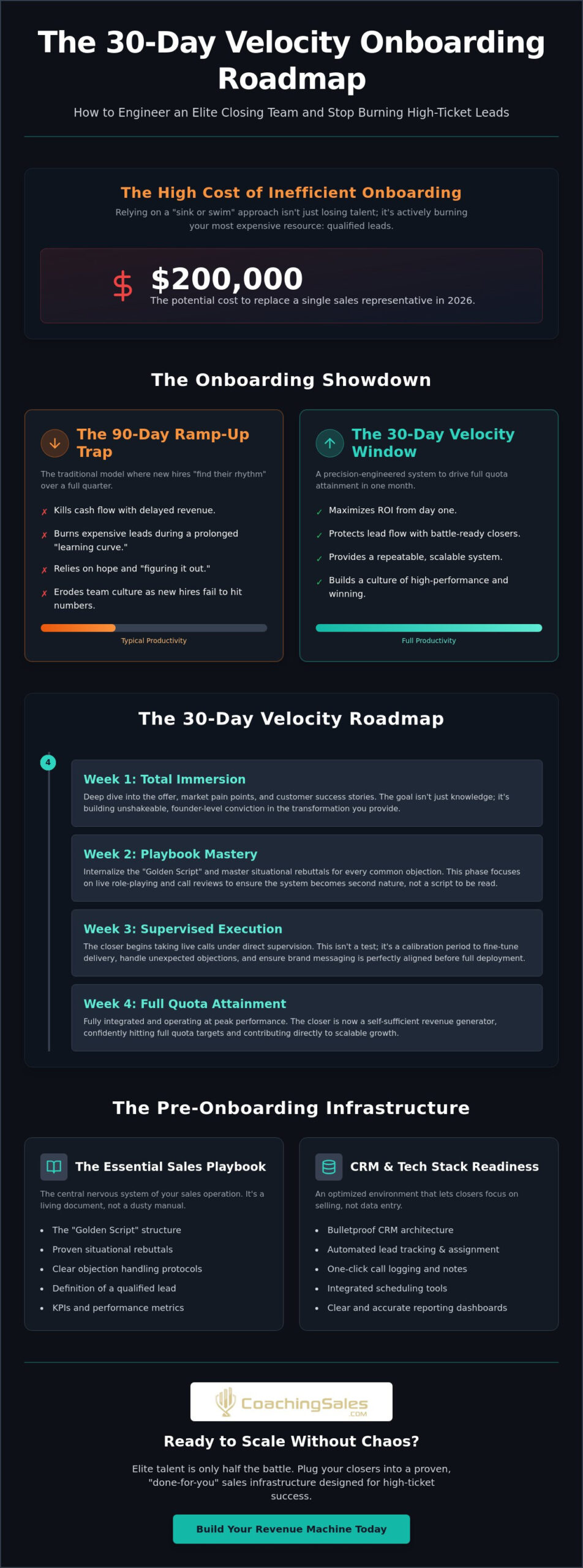
The 30-Day Velocity Roadmap for Elite Closers
Speed is the ultimate competitive advantage in high-ticket sales. While most firms accept a sluggish three to six month ramp-up period, elite organizations don't have that kind of patience. A world-class sales onboarding process for closers compresses this timeline into thirty days of high-intensity, precision-engineered execution. It's not about rushing the person; it's about eliminating the systemic friction that slows down high-performers. If your closer isn't generating ROI by week four, your process is broken.
The roadmap is divided into clear, non-negotiable phases. Days one through three are dedicated to deep immersion. The closer must master the product, the market, and your infrastructure before they even think about a lead. Days four through seven shift to simulation and shadowing. They need to hear what a “win” sounds like and prove they can replicate it in roleplay scenarios. By day eight, they move into controlled execution, taking live calls under a microscope. The final ten days focus on optimization. This is where you analyze the data, identify revenue leaks, and prepare them for full-scale production.
Week 1: The Knowledge Sprint
The first week is a sprint to internalize the Sales Playbook. If a closer cannot articulate your core offer with founder-level conviction by Friday, they are a liability. You must put them through an “Objection Gauntlet.” This is a mandatory certification where they face every brutal rebuttal your market offers. Set clear KPIs for the first 30 days immediately. In month one, winning isn't just about revenue; it's about demonstrating total mastery of the sales cycle and hitting leading indicators consistently.
Weeks 2-4: The Feedback Loop
Feedback loses its power if it isn't delivered while the conversation is fresh. Implement a mandatory 24-hour call review process for every new hire. You aren't just looking at the “Closed-Won” column. You're tracking appointments held, offer rates, and follow-up speed. These leading indicators are the early warning system for your revenue. Organizations that prioritize this level of structure improve new hire productivity by 70%. You can accelerate this transition by optimizing sales team performance through coaching. If you are ready to stop micro-managing and start scaling, it's time to invest in professional sales coaching to solidify your team's foundation.
Scaling Without Chaos: The Coaching Sales Advantage
Recruiting elite talent is only 50% of the battle. You can hire the most aggressive closer in the industry, but if you plug them into a fragmented system, they'll churn within 90 days. High-performance talent requires a high-performance environment. A truly effective sales onboarding process for closers doesn't stop at the 30-day mark. It evolves into a culture of continuous optimization. A-players don't want to “figure it out.” They want to win. If you provide the machine, they'll provide the revenue.
To maximize your team's calendar capacity, you must implement a “Setter-Closer” dynamic. This allows your closers to focus exclusively on high-leverage conversations while your setter program handles the volume. It's the only way to scale toward $10M+ without the founder becoming a permanent bottleneck. Stop trying to make your closers do their own prospecting. Separate the roles to ensure every minute of your closer's day is spent in the “Closing Zone.”
Recruiting and Placement
Coaching Sales doesn't just “find people.” We source and vet high-performance closers who are battle-tested in high-ticket environments. We analyze thousands of candidates to find the top 1% who actually understand the psychology of a $10k+ commitment. Our vetting process involves rigorous roleplay and background verification of past performance. We don't settle for “potential.” We hire for “proven results.”
We focus on commission-only, performance-based teams because it aligns incentives perfectly. If they don't produce, you don't pay. This model reduces the risk of a bad hire that could cost you upwards of $200,000 in lost leads and replacement costs. Expert placement ensures you're hiring for a specific role within a specific sales onboarding process for closers, rather than just filling a seat with a warm body.
The Infrastructure for $10M+
Scaling to eight figures requires you to move from operational involvement to a leadership or investor role. You cannot do this if you're still reviewing every single call or manually assigning leads. Custom playbooks and setter programs remove you from the day-to-day chaos. They provide the “Done-For-You” infrastructure that allows your business to breathe. This shift isn't just about revenue; it's about freedom.
When the system is bulletproof, the talent is replaceable, and the revenue is predictable. You move from being the “Chief Sales Officer” to the “Strategic Visionary.” When you have a setter program filtering the noise and a closer team executing the playbook, your only job is to look at the scoreboard and make high-level adjustments. This is how you build a sellable asset rather than just a high-paying job for yourself. Ready to scale? Let Coaching Sales build your elite sales team.
Take Command of Your Revenue Engine
Transitioning from founder-led sales to a scalable, high-performance team is the ultimate test for any ambitious business owner. It requires moving beyond hope and installing a precision-engineered sales onboarding process for closers. You've seen how a 30-day velocity roadmap and a “Done-For-You” infrastructure can turn a high-risk hire into a predictable revenue generator. It's time to stop burning expensive leads and start owning your market with absolute certainty.
Real growth happens when you finally step out of the sales seat. By leveraging expert sales coaching for $10M+ growth and a proven Setter Program for calendar saturation, you create a system that thrives without your constant oversight. You don't need more “potential” or “unproven theories.” You need vetted ‘Done-For-You' sales closers who can execute your custom playbook with surgical precision from day one. The roadmap is ready, and the machine is built for your success.
Scale your high-ticket offer with vetted closers and custom playbooks
The path to an eight-figure exit is built on the systems you install today. Build them with conviction and move forward.
Frequently Asked Questions
How long should it take to onboard a high-ticket sales closer?
An elite closer should reach full quota attainment within exactly 30 days. While generic corporate cycles often drag on for three to six months, a precision-engineered sales onboarding process for closers compresses this timeline into a four-week velocity roadmap. You move from deep immersion in week one to solo execution by day eight; ensuring ROI is generated before the first month concludes.
What are the most important KPIs to track during sales onboarding?
Prioritize leading indicators such as appointments held, offer rate, and speed-to-lead during the initial weeks. These metrics provide an early warning system for performance before you ever see the final revenue numbers in your CRM. If a new hire hits these leading indicators consistently, the lagging indicators like cash collected and total ROI will inevitably follow.
Should I provide a base salary or go commission-only for new closers?
High-ticket offers in the coaching and consulting space typically thrive on a commission-only structure ranging from 8% to 15%. This ensures total alignment between the closer's income and your business growth. In established SaaS or B2B professional services, a base salary plus a 5% commission is more common to manage the complexity of longer enterprise sales cycles.
What is the biggest mistake founders make when onboarding closers?
The biggest mistake is assuming an elite closer can succeed through osmosis. Founders often expect new hires to possess their “intuitive market knowledge” without providing any formal documentation. Without a structured sales onboarding process for closers, you're simply burning expensive leads and hoping for a miracle rather than building a repeatable revenue machine.
How do I know if a closer is a ‘bad hire' or just needs more training?
Look at the leading indicators and process adherence to make this distinction. If the closer is following the sales playbook but failing to convert, it's a training gap that requires coaching. If they're ignoring the system and trying to “wing it” on live calls, you have a bad hire who will eventually poison your team culture and burn your reputation.
Can I onboard a closer without a formal sales playbook?
No. You cannot scale a high-ticket offer without a formal sales playbook. Attempting to onboard without one means you have no baseline for what “good” looks like; which leads to inconsistent performance. You'll spend all your time micro-managing individual calls instead of leading your organization toward $10M+ growth and operational freedom.
What tools are essential for a remote sales onboarding process?
You need a robust CRM like HubSpot or Salesforce; call recording software for rapid feedback; and a dedicated communication hub for daily reviews. These tools allow you to automate the administrative work so your closers can focus on high-leverage conversations. In 2026, using AI-powered coaching tools to analyze sales conversations is also a critical component for scaling quickly.
How many calls should a new closer shadow before taking their own?
A new hire should shadow 3 to 5 live calls conducted by the founder or a top performer. Once they've mapped the emotional arc of a successful close, you must reverse the roles immediately. Shadow the new closer for another 3 to 5 calls and provide rigorous, no-nonsense debriefs after each session to catch technical errors before they become permanent habits.