

If your fragmented technology stack is leaking 30% of your annual revenue through data silos, your high lead volume isn't a win. It's a liability. You're likely drowning in dashboard metrics but still can't explain why one rep consistently hits their targets while three others miss. It's a common trap in high-ticket environments where high volume often masks deep-seated inefficiencies and inconsistent performance across the floor.
We agree that gut feel is a liability in a 2026 marketplace where 80% of B2B interactions are digital. To navigate this landscape, programs like the Achieve With Nate Movement offer the technology training and digital confidence coaching required to manage these systems effectively. You need an unapologetic approach to sales team kpi tracking that prioritizes revenue orchestration over simple activity counts. If you don't measure the system, you can't scale the results. It's that simple. This is about moving from operational involvement to high-level leadership by mastering the data that actually moves the needle.
This guide provides the exact checklist required to audit your sales performance and stop the revenue leaks. You'll learn how to master the specific metrics that drive ROI on your sales talent and lead spend. We're moving past the noise to establish a framework for predictable revenue forecasting and elite-level execution.
Key Takeaways
- Ditch vanity metrics like total call volume to focus on high-intent lead conversion and premium revenue efficiency.
- Implement the high-ticket activity checklist, featuring the critical 75% setter show-up rate benchmark, to ensure your calendar stays profitable.
- Master Revenue Per Lead (RPL) as your ultimate North Star metric for measuring the real ROI of your sales talent and lead spend.
- Refine your sales team kpi tracking by monitoring rep ramp times and retention to eliminate the massive hidden costs of turnover.
- Learn how to audit your sales playbooks for tracking gaps and bridge the distance between raw data and actual dollars.
High-Ticket KPI Tracking vs. Generic Sales Metrics: What Matters in 2026
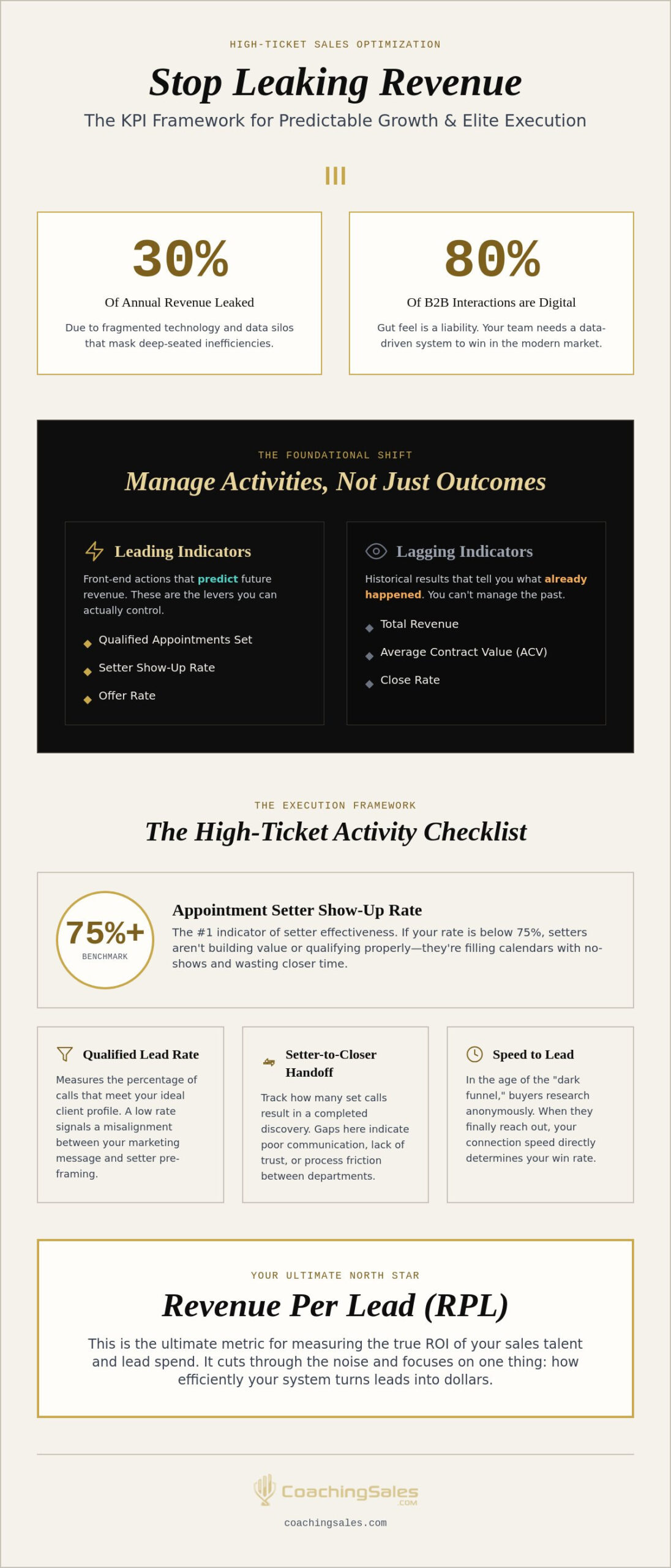
High-ticket sales aren't a numbers game. They're a conversion game. In a market where fragmented technology stacks can leak up to 30% of your annual revenue, you can't afford to track the wrong things. High-ticket KPI tracking is the precise measurement of how efficiently your system converts high-intent leads into premium revenue. It's the difference between scaling a predictable machine and throwing money at a broken funnel.
Most teams are still obsessed with vanity metrics. They track total call volume and “hours on the dialer” like it's 1995. This approach is killing your ROI. In 2026, 80% of B2B sales interactions are digital. If your reps are making 100 calls a day to unqualified leads, they aren't working hard; they're wasting your lead spend. Before you can optimize, you must understand the foundational principles of What is a KPI? in a high-stakes environment. It isn't just a number. It's a signal of health or a warning of impending failure.
The Lagging vs. Leading Indicator Framework
Revenue is a lagging indicator. It tells you what happened last month, but it gives you zero control over what happens tomorrow. You can't “manage” revenue. You can only manage the activities that create it. This is why sales team kpi tracking must focus on leading indicators. These are the front-end actions that predict future bank deposits. If your qualified appointment volume drops today, your revenue will drop in 30 to 90 days. Leading indicators are the levers of sales growth.
- Lagging Indicators: Total Revenue, Average Contract Value (ACV), Close Rate.
- Leading Indicators: Qualified Appointments Set, Show-up Rate, Offer Rate.
Why Generic KPIs Fail High-Ticket Teams
Generic sales metrics fail because they treat all activity as equal. In a high-ticket environment, a closer's “time on phone” is a useless metric. A ten-minute call that ends in a $20,000 deposit is infinitely more valuable than a two-hour “consultation” that ends in a “let me think about it.” You aren't paying for talk time. You're paying for conversion. Traditional SaaS metrics often prioritize “cost per lead,” but high-ticket winners focus on “cost per qualified appointment.”
High-ticket sales cycles are nuanced. They require a “coaching-first” leadership style that uses sales team kpi tracking to identify skill gaps rather than just punishing low activity. If your qualified lead rate is high but your closing rate is low, the problem isn't your lead source. It's your sales playbook or your closer's execution. Stop measuring the noise and start measuring the infrastructure that actually generates profit.
The High-Ticket Activity Checklist: Input Metrics That Drive Output
Stop guessing why your revenue is stagnant. If you aren't tracking the specific inputs that fuel your funnel, you'll never control the outputs in your bank account. High-ticket sales team kpi tracking isn't about counting every random dial; it's about auditing the quality of every strategic touchpoint. While generic models focus on volume, high-growth teams focus on the efficiency of the “set” and the precision of the “close.”
Before you dive into complex data, you need a baseline. Industry leaders often cite 9 critical sales KPIs as a standard for general business, but high-ticket environments require a tighter filter. Use this checklist to identify where your system is leaking cash:
- Appointment Setter Show-Up Rate (Target: 75%+): If your show-up rate is below 75%, your setters aren't selling the value of the appointment. They're just filling a calendar with ghosts.
- Qualified Lead Rate: This measures the percentage of booked calls that actually meet your pre-defined buying criteria. If this is low, your marketing and setter pre-frames are misaligned.
- Setter-to-Closer Handoff Efficiency: Track how many set calls result in a completed discovery or pitch. Gaps here indicate a lack of trust or poor communication between departments.
- Connection Rate vs. Response Time: In 2026, the “dark funnel” means buyers research anonymously. When they finally reach out, your speed to lead determines your win rate.
Measuring Setter Performance
Your setters are the gatekeepers of your closer's time. Track the number of outbound touches required to book one qualified call to understand your true cost of acquisition. Within a high-performance Setter Program, “Calendar Capacity” is a vital metric. It ensures your team isn't just busy, but is actively maximizing the available slots with high-intent prospects. You must also track setter “DNA”—the quality of the pre-frame. A setter who builds massive tension and desire before the closer even picks up the phone is worth ten “order takers.”
The Closer Activity Audit
Stop looking at a closer's total closing rate. It's a vanity metric that includes junk leads they never should have spoken to. Instead, track the closing rate on “Qualified” leads only. This gives you a pure look at their skill level. You should also monitor “Offer Strength.” If your team has a high “no-offer” rate, they're likely disqualifying people based on price objections they don't know how to handle. Finally, track “Follow-Up Persistence.” Most high-ticket deals don't close on call one; they close on touchpoint five, six, or seven. If your reps stop after the first “no,” they're leaving millions on the table. It's time to audit your sales team's performance and demand higher standards.
Revenue & Efficiency KPIs: Measuring Your Sales Infrastructure ROI
Revenue is the goal, but efficiency is the metric that determines if you actually keep the money you make. In high-ticket coaching and consulting, the gap between Annual Contract Value (ACV) and Lifetime Value (CLV) can be the difference between a struggling agency and a market leader. If you aren't optimizing for the ROI of your entire infrastructure, your sales team kpi tracking is incomplete. You need to know exactly what every lead is worth and how fast they move through your pipeline. High-growth teams don't just close deals; they engineer them for maximum profitability.
Fragmented technology stacks cost organizations between 20% and 30% of their annual revenue due to data silos and administrative burden. This is “Lead Leakage” in its purest form. If your leads are falling out of your Custom Sales Playbooks because of poor tracking or manual errors, you're burning cash. High-performers don't tolerate leakage. They use precise frameworks to understand how to track sales metrics that actually impact the bottom line.
Calculating Revenue Per Lead (RPL)
Revenue Per Lead is the ultimate health check for your sales system. The formula is simple: Total Revenue divided by Total Leads. This single number tells you if your marketing and sales teams are in sync. If your RPL is $500 and your cost per lead is $600, you have a math problem, not a sales problem. Use RPL to determine exactly how much you can afford to pay for a lead while maintaining your desired margins. To maximize this metric, agencies targeting niche markets often leverage LeadOpsIQ to gain weekly intelligence on high-intent restoration and HVAC leads, ensuring they only feed their sales engine with the highest-potential opportunities. It removes the guesswork from scaling and allows for aggressive, confident growth. If the RPL is rising, your sales system is getting stronger.
Sales Velocity: The Speed of Scale
Speed is a competitive advantage in high-ticket markets. Sales Velocity measures how fast your leads move from the initial opt-in to a “Closed-Won” status. To calculate this, multiply your Number of Opportunities by your Deal Value and your Win Rate, then divide that total by the Length of your Sales Cycle. If you want to increase revenue without increasing lead spend, you must shorten the cycle.
Shortening the cycle doesn't mean sounding desperate or pushy. It means removing friction from the buying journey. By 2026, 80% of B2B sales interactions are expected to occur digitally. This means your digital sales environment must be as efficient as your human closers. If your process is slow, your prospects will find someone who moves at the speed of their business. Master the velocity, and you master the market.
The Human Factor: Tracking Team Health and Performance Ramp
Data tells you what happened. People tell you why. If your sales team kpi tracking ignores the human element, you're missing the most volatile variable in your revenue equation. High-ticket sales require elite mental endurance and technical precision. You can't just plug a body into a seat and expect high-performance results. You must track how fast they become profitable and how long they stay at the top of their game. A high-performance culture is built on measurable improvement, not just motivational speeches.
Start by tracking the “Coaching Impact” metric. Are your reps improving month-over-month? Implementing a rigorous sales team kpi tracking protocol should include analyzing skill gaps for targeted training. Research shows that data-driven coaching can increase team engagement by 20% to 30%. If your metrics aren't identifying specific execution errors, you aren't leading; you're just supervising. High-ticket environments demand a “coaching-first” leadership style that treats every lost deal as a data point for the next win.
Optimizing the Onboarding Ramp
A world-class ramp for a high-ticket closer follows a strict 30-60-90 day plan. By day 30, they should master the product and the pre-frame. By day 60, they should be taking a full load of qualified calls. By day 90, they must hit 100% of their quota. If they haven't achieved this, the placement is likely a failure. Utilizing High Ticket Sales Coaching accelerates this ramp time by providing a proven roadmap for execution. Watch for red flags in the first 30 days. If a rep isn't asking deep questions about lead quality or doesn't implement feedback immediately, they won't survive the pressure of a high-growth environment.
The ROI of Sales Talent
The cost of a bad hire is catastrophic. It isn't just the lost commission; it's the burned lead spend and the missed opportunity cost. Top quartile reps in 2026 generate between $750,000 and $1.2M in annual revenue. If your reps aren't hitting these benchmarks, you're losing money every day they remain on the floor. Compare the cost of elite High Ticket Sales Recruiting: The Elite Hiring Blueprint for 2026 against the price of a “bad fit” closer who leaks revenue. When you track the performance of Done For You Sales Closers, you're measuring the health of your entire acquisition engine. Retention is the hidden profit lever. High turnover is usually a sign of a broken system, not just bad luck. Recruit elite talent today to stop the turnover bleed and start building for 2026.
Implementing Your Tracking System: From Data to Dollars
Software doesn't scale companies. Systems do. Most founders make the mistake of buying expensive CRMs before they've defined their human infrastructure. If your sales team kpi tracking is built on top of a broken process, you're just measuring how fast you're losing money. You need a transition from operational chaos to predictable revenue orchestration. This requires a ruthless commitment to data integrity and a clear roadmap for implementation.
Follow these five steps to turn your raw data into a scalable revenue machine:
- Step 1: Audit your Sales Playbooks. Start by checking your existing Sales Playbooks for tracking gaps. If your playbook doesn't define exactly when a lead moves from “Set” to “Qualified,” your data will be inconsistent.
- Step 2: Choose your North Star. For high-ticket teams in 2026, this is almost always Revenue Per Lead (RPL). It's the ultimate measure of your system's health.
- Step 3: Establish a Pulse Report. Set up a daily and weekly report for the leadership team. You can't wait until the end of the month to discover a lead leakage problem.
- Step 4: Conduct Weekly Film Reviews. Tie your KPIs to actual behavior. If the closing rate is down, listen to the calls. Data tells you where to look; film tells you what to fix.
- Step 5: Iterate based on “Off-Piste” data. Markets change. If your performance data shows a shift in buyer intent, update your scripts and setters immediately.
Building the Tracking Infrastructure
Your CRM must support the high-ticket handoff. In 2026, the shift toward platform consolidation means you should avoid the “Franken-stack” of disconnected tools. You need a unified data fabric that tracks the journey from the first setter touch to the final closer deposit. Automated dashboards are essential for speed, but they rely on manual integrity. If your reps aren't inputting clean data, your “North Star” is a lie. Demand absolute accuracy. If it isn't in the CRM, it didn't happen. This discipline is what separates elite teams from those drowning in administrative burden.
The Feedback Loop: Coaching with KPIs
Predictable sales team kpi tracking allows you to diagnose and cure performance issues with surgical precision. A low closing rate isn't a mystery. It's usually a specific script failure or a lack of tension in the discovery phase. When you see the numbers dip, you don't guess. You listen to the recordings and identify the exact moment the deal was lost. Similarly, a high no-show rate isn't just a “bad lead” problem. It's a signal that your lead-nurturing strategy is failing to build enough desire before the call. Fix the nurture, and the show-up rate follows. Once these metrics are predictable, you have permission to scale. Pouring more leads into a tracked, optimized system is how you achieve exponential growth without the typical growing pains.
Scale Your Revenue with Certainty
Revenue is the byproduct of a disciplined system. You've seen how vanity metrics mask inefficiency and how leading indicators predict your bank balance 90 days out. Master your sales team kpi tracking by focusing on Revenue Per Lead and human performance ramp times. If you don't control the data, the market will control you. It's time to stop treating your sales floor like a black box and start treating it like a high-performance engine.
We've placed over 1,000+ high-ticket closers and built the proven infrastructure required for $10M+ scaling. Our team of battle-tested sales experts has no patience for fluff or unproven theories. We provide the roadmap; you execute the growth. The distance between where you are and where you want to be is measured in the precision of your metrics. Don't leave your scaling to chance when you can build on a foundation of absolute certainty.
Stop guessing and start scaling—get a custom Sales Team Audit and Playbook from Coaching Sales.
Build the system. Track the results. Dominate your market.
Frequently Asked Questions
What is the most important KPI for a sales team in high-ticket sales?
Revenue Per Lead (RPL) is the most critical metric for high-ticket environments because it bridges the gap between lead spend and bank deposits. While other metrics focus on activity, RPL measures the health of your entire acquisition engine. It tells you exactly how much every lead is worth to your business. This allows you to scale your marketing spend with absolute confidence rather than guessing on your return on investment.
How do I track sales KPIs without micromanaging my closers?
Use automated dashboards and outcome-based reporting to monitor performance without hovering over your reps. Effective sales team kpi tracking relies on a clear Sales Playbook where expectations are predefined. If the data is transparent and visible to the whole team, accountability becomes part of the culture. You don't need to micromanage when the numbers clearly show who is executing the system and who is falling behind.
What is a good closing rate for high-ticket sales in 2026?
A strong closing rate for high-ticket deals in 2026 typically ranges between 15% and 25% depending on the deal size. For smaller high-ticket deals, aim for the 20% to 25% bracket. For larger enterprise deals, 15% to 20% is considered top-tier performance. If your rates fall below these benchmarks, it's a signal to audit your lead qualification process or closer execution. High performers focus on the quality of the offer rate.
Can I track sales KPIs using just a spreadsheet?
You can use a spreadsheet, but it is a massive risk to your revenue. Fragmented technology stacks and manual data entry are estimated to cost organizations 20% to 30% of their annual revenue. Spreadsheets create data silos and make real-time decision-making impossible. In a high-stakes environment, you need a unified CRM that automates the handoff from setter to closer to ensure no lead falls through the cracks.
How often should I review sales team KPIs with my staff?
Review your high-level metrics daily and conduct deep-dive coaching sessions every week. High-growth teams use daily pulse reports to catch performance dips before they become monthly disasters. Weekly film reviews are essential to tie your sales team kpi tracking to actual sales behavior on the phone. This frequency ensures that your feedback loop is tight enough to correct errors in real-time rather than waiting for a quarterly review.
What is the difference between a sales metric and a sales KPI?
A sales metric is a raw data point, while a KPI is a strategic indicator of success. For example, total dials made is a metric that tracks activity. The Lead-to-Opportunity conversion rate is a KPI because it measures the effectiveness of your sales strategy. You should track many metrics but only focus on a few North Star KPIs that directly impact your ability to scale revenue and profit.
How do I know if my sales ramp time is too slow?
Your sales ramp time is too slow if a new rep isn't hitting 100% of their quota by the 90-day mark. A world-class onboarding plan should see a closer mastering the product by day 30 and taking a full lead load by day 60. If they are still struggling to close qualified leads after three months, your training infrastructure or your hiring criteria is likely the bottleneck. Investing in structured sales training programs for teams that reinforce skills beyond the initial onboarding period is one of the most effective ways to close this gap and accelerate time-to-quota.
What happens if my sales team hits their activity KPIs but not their revenue goals?
This discrepancy usually reveals a breakdown in lead quality or a failure in the sales script. If your team is making the calls and setting the appointments but the revenue isn't following, you are likely measuring the wrong activities. It often means your setters are booking junk leads to hit their numbers or your closers aren't following the Sales Playbook. You must audit the offer rate to see where the value is being lost. If skill gaps are the root cause, evaluating the right sales training programs for teams can provide the structured reinforcement needed to turn inconsistent performers into reliable revenue producers.