
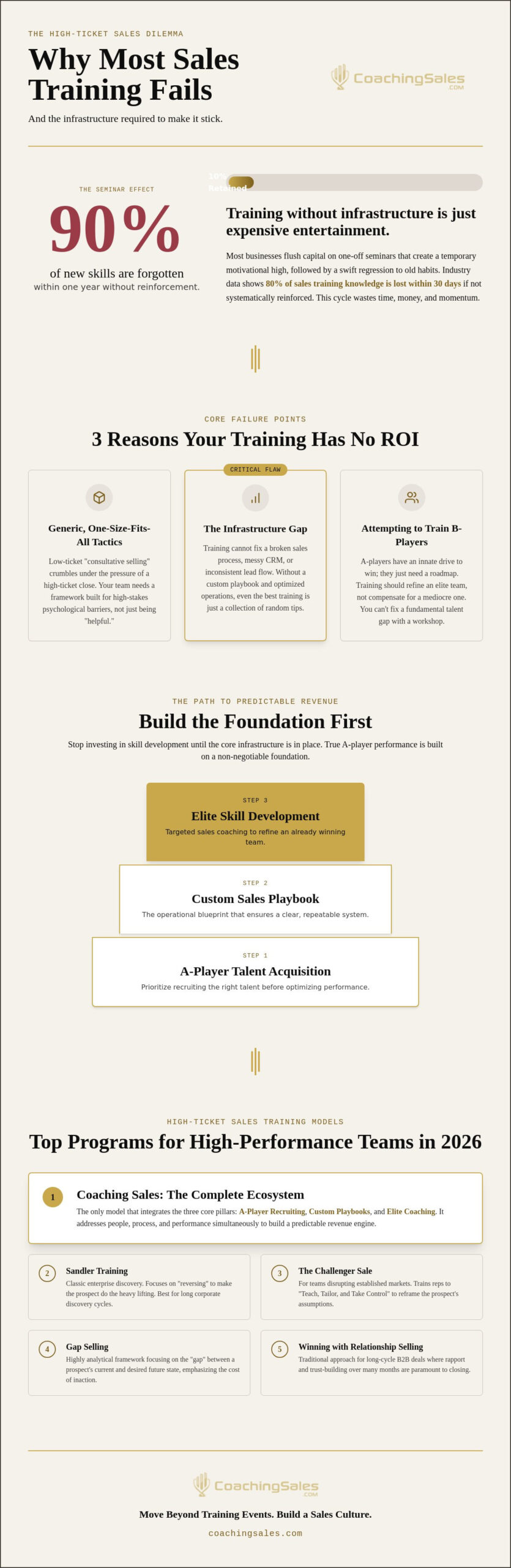
90% of the new skills your reps learn this week will be completely forgotten within a year without a system to reinforce them. It's a staggering waste of capital that most high-ticket founders simply accept as the cost of doing business. You know the cycle. You pay for a high-energy seminar, the team feels motivated for forty-eight hours, and then they regress to their old, inconsistent habits. If your closing rates vary wildly across the floor and new hires take months to reach quota, your current approach to sales training programs for teams is failing you.
It's time to stop treating training as a one-off event and start viewing it as a core infrastructure requirement. This 2026 roundup reveals the elite programs designed to scale high-ticket teams and the specific systems you need to make that training stick. You'll discover how to build a self-sustaining sales culture that produces A-player performance from every seat. We are breaking down the managed training models, the ROI of reinforcement, and the exact roadmap to transition your sales floor into a predictable revenue engine.
Key Takeaways
- Stop flushing capital on one-off seminars that lack a structured reinforcement system to combat the “Seminar Effect.”
- Discover the top-tier sales training programs for teams that integrate recruiting and playbooks to ensure high-ticket performance actually sticks.
- Learn to identify your primary revenue bottlenecks so you can select a training model that targets specific leaks in your setter or closer performance.
- Build the necessary infrastructure first by prioritizing elite talent acquisition and custom sales playbooks before investing in skill development.
- Move beyond DIY video courses and embrace “Done-With-You” implementation to create a predictable, self-sustaining sales culture.
Why Most Sales Training Programs for Teams Fail High-Ticket Businesses
Most sales training programs for teams fail because they treat high-ticket closing like a commodity. High-ticket sales training isn't about teaching people how to be “nice” or “helpful.” It is the aggressive optimization of team performance for complex, high-value transactions. If you're selling a $20,000 service, a generic consultative approach isn't enough. You need conviction. You need a team that understands how to navigate high-stakes psychological barriers. Most programs offer surface-level tactics that work for software subscriptions but crumble when a prospect is asked to wire five figures.
We see it constantly. A founder spends thousands on a high-energy weekend workshop. The team is fired up on Monday. By Friday, they've reverted to their old, lazy habits. Industry data suggests that 80% of sales training is forgotten within 30 days without a robust reinforcement system. This “Seminar Effect” is a silent killer of ROI. Training without infrastructure is just expensive entertainment. If you don't have a way to track, measure, and correct behavior daily, you're just flushing capital down the drain.
Stop trying to train B-players into stars. It's a losing game. A-players don't need to be taught how to want to win; they need the right roadmap. Training should refine an elite team, not compensate for a mediocre one. If your team lacks the core drive to close, no amount of sales coaching will fix the fundamental talent gap. You must prioritize recruiting the right talent before you try to optimize their performance.
The High-Ticket Difference: Complexity and Conviction
High-ticket sales require deeper psychological discovery than low-ticket ecommerce. You aren't selling a widget. You're selling a high-stakes transformation. One-size-fits-all programs lead to revenue plateaus because they ignore the nuances of your specific offer. Your team needs the conviction to lead the prospect through a high-pressure decision. They shouldn't just be answering questions. They must be trained to challenge the prospect's limiting beliefs and maintain authority throughout the entire call.
The Infrastructure Gap in Modern Training
Training cannot fix a broken sales process or a lack of qualified leads. If your CRM is a mess and your lead flow is inconsistent, no amount of coaching will save your revenue. Your infrastructure must be optimized first. This starts with a custom sales playbook. This document serves as the foundation for everything. It ensures that when you do invest in sales training programs for teams, the reps have a clear, repeatable system to execute. Without a playbook, your training is just a collection of random tips that never translate into predictable revenue.
The 5 Best Sales Training Programs for High-Performance Teams in 2026
Most sales training programs for teams are designed for retail environments or low-ticket software. They lack the teeth required for high-ticket closing. If you are scaling an offer above $10k, you need a framework that builds authority and handles sophisticated resistance. Not all programs are created equal. Here are the top contenders for 2026 that actually drive revenue.
- Coaching Sales: This is a complete high-ticket ecosystem. We don't just offer videos. We combine Sales Recruiting with custom Sales Playbooks and elite Sales coaching. It is the only program that addresses the people, the process, and the performance simultaneously.
- Sandler Training: A classic for enterprise-level discovery. Sandler focuses on “reversing” and ensuring the prospect does the heavy lifting. It is ideal for traditional corporate environments where long discovery cycles are the norm.
- The Challenger Sale: Best for teams disrupting established markets. It trains reps to “Teach, Tailor, and Take Control.” This methodology forces prospects to rethink their current business assumptions rather than just comparing features.
- Gap Selling: This approach focuses entirely on the “space” between a prospect's current state and their desired future state. It is a highly analytical framework that strips away fluff and focuses on the financial cost of inaction.
- Winning with Relationship Selling (Dale Carnegie): Effective for long-cycle B2B deals. While more traditional, it excels in industries where multi-year contracts depend heavily on rapport and trust-building over several months.
Specialized Training for Setters and SDRs
Your outbound team needs a different curriculum than your closers. Setters are the gatekeepers of your calendar. They don't need to master the final contract; they need to master the “set.” An elite Sales Setter Program focuses on appointment-setting frameworks and rapid lead qualification. If your setters cannot filter out the tire-kickers, your closers will burn out on unqualified calls. You must train them to identify pain points in under ten minutes.
Advanced Closing Frameworks for Remote Teams
In 2026, the sales floor is digital. You must optimize for Zoom-based high-ticket environments. This means lighting, background authority, and screen-sharing transitions matter as much as the script. Handling high-level objections in a remote setting requires immediate “game tape” analysis. If you aren't reviewing call recordings weekly, you aren't training. You are just guessing. Use data-driven feedback to correct tone and pacing in real-time. If your team is struggling to hit their numbers, it might be time to invest in professional Sales coaching to identify the leaks in your remote process.
Evaluating ROI: How to Choose a Sales Training Program That Scales
Stop treating training as a “check-the-box” activity. If you want to scale a high-ticket offer, you must treat sales training programs for teams as a high-yield investment. Most founders look at the price tag first. This is a mistake. You should look at the bottleneck first. If your lead volume is high but your calendar is empty, you don't need a closing course. You need a setter program. If your show-up rate is elite but your close rate is abysmal, your reps lack conviction or process. Identify the specific leak in your revenue engine before you write a check.
Demand “Done-With-You” implementation. The market is saturated with “Do-It-Yourself” video libraries that collect digital dust. High-performers don't need more content; they need execution. Look for programs that provide live call reviews, real-time feedback, and custom playbook integration. If a program doesn't integrate with your specific sales stack and CRM, it won't stick. Data must flow from the training sessions directly into your daily operations. If it isn't in the CRM, it didn't happen. Prioritize programs that offer ongoing coaching over one-off seminars to ensure the “Seminar Effect” doesn't cannibalize your ROI.
Measuring the Metrics That Matter
Completion rates are a vanity metric. You aren't running a school; you're running a business. The only metric that matters is revenue per rep. You must track how training impacts your bottom line in real-time. Use sales team KPI tracking to validate your training ROI. This allows you to see exactly which reps are applying the new frameworks and which ones are falling behind. Monitor the “Ramp-to-Quota” time for every new hire. An elite training system should cut this time in half, moving a new closer from “onboarding” to “revenue-generating” in weeks, not months.
The Scalability Test
Ask yourself a simple question: Can this training be replicated as you hire ten more closers? If the answer is no, the program is a liability. You must avoid “Founder-Dependent” training models. If you are the only one who can train the team, you don't have a scalable business; you have a job. Look for systems that utilize automated onboarding and standardized playbooks. This ensures that every new hire receives the same high-level instruction without requiring your constant involvement. A truly scalable system turns training into a repeatable process that functions perfectly whether you are in the room or not. Understanding how to motivate a sales team through systems architecture rather than personality management is what separates founders who scale from those who plateau.
Beyond the Course: Building the Infrastructure for Training to Stick
Training is the final polish, not the foundation. If you invest in sales training programs for teams before you've secured elite talent and a bulletproof process, you're building on sand. Most training fails because it's applied to the wrong people using a broken map. You must follow the correct order of operations: People, then Process, then Performance. When evaluating sales training programs for teams, ensure they acknowledge that skills are secondary to the system that supports them.
You cannot train your way out of a hiring mistake. If a rep isn't coachable, no amount of coaching will fix their closing rate. This is why you must hire high-ticket sales closers who possess the baseline drive and psychological profile to win. Once the right people are in the seats, you need the “Playbook First” rule. Training is simply the live execution of that playbook. Without it, your team is just improvising and hoping for the best.
The Custom Sales Playbook: Your Team's Bible
A playbook ensures every rep speaks the same language. It's the difference between a disorganized group of individuals and a cohesive unit. A $10M+ playbook includes specific scripts, deep-dive objection handling, and precise CRM workflows. It removes the guesswork. When a new hire starts, they don't wonder what to say; they follow the script. This reduces training friction by 70% because the “what” is already decided. The training then focuses entirely on the “how”, the tone, the pacing, and the conviction.
Elite Recruiting as the Ultimate Training Shortcut
Stop trying to turn “C-players” into “A-players.” It's a waste of your most valuable resource: time. The ROI of placing a vetted closer far outweighs the cost of trying to fix a novice. Elite recruiting firms find talent that isn't browsing job boards. These are the “silent killers” who are already at quota elsewhere but want a better offer or a bigger challenge. When you start with A-players, your training sessions become high-level strategy meetings rather than remedial lessons.
Building a high performance sales culture of radical candor is the final piece. You need a team that thrives on constant feedback and game tape reviews. If your reps are too sensitive to hear the truth about their performance, they don't belong on a high-ticket floor. Demand excellence. Provide the tools. Then, get out of the way. If your current infrastructure is holding you back, it's time to invest in professional Sales coaching to build a revenue engine that produces predictable results.
The Coaching Sales Ecosystem: Turning Training into Predictable Revenue
Coaching Sales does not sell “tips.” We build revenue engines. While other sales training programs for teams focus on classroom theory, we focus on the mechanical reality of your sales floor. Training in a vacuum is useless. To achieve predictable growth, you must align your people, your process, and your performance into a single, cohesive ecosystem. We move you past the “founder-led sales mess” and install a professional department that functions without your constant intervention.
Our Done-for-you closer placement ensures you have the right talent from Day 1. We don't just find people who “can sell.” We find people who fit your specific high-ticket offer. Once the talent is in place, we build the custom Sales Playbooks that make your training permanent. These playbooks serve as the operational manual for your business. They turn tribal knowledge into a documented, scalable asset. When every objection is mapped and every workflow is defined, your team stops guessing and starts executing.
The Setter-to-Closer Pipeline
A consistent calendar is the lifeblood of a high-ticket team. Our Setter Program is designed to feed your closers a steady stream of qualified prospects. We optimize the handoff process to ensure no leads leak out of the funnel during the transition. This creates a seamless experience for the prospect and maintains high momentum. A vetted setter and an elite closer function like a precision-guided missile; they turn cold interest into cleared wires with mechanical efficiency. This synergy allows your closers to focus entirely on the high-value activity of closing rather than chasing down appointments.
Scale Without Chaos
The goal of scaling is to move you into a true “Investor” role. You cannot lead a $10M+ company if you are still taking sales calls or micromanaging every follow-up. Our 2026 roadmap for high-ticket scaling focuses on delegating the sales function to a self-sustaining team. This requires a shift from operational involvement to strategic leadership. We provide the infrastructure, the talent, and the high ticket sales coaching necessary to make this transition possible. You provide the vision; we provide the machine that powers it.
If you are tired of inconsistent revenue and a team that only performs when you are watching, it is time to build a real system. Stop looking for another course and start building an ecosystem. Book a strategy session with Coaching Sales today to audit your current sales floor and identify the exact path to predictable, high-ticket scale.
Dominate the High-Ticket Market with a Proven System
The gap between a plateaued business and a scaling empire is the infrastructure behind the sales floor. You've seen why generic sales training programs for teams fail. They lack the specialized focus required for $3k to $50k+ offers. To win in 2026, you must stop treating skills as a band-aid for broken processes. Start by securing elite talent and documenting your custom sales playbook. Only then will your training translate into predictable revenue.
At Coaching Sales, we've placed over 1,000 closers into high-ticket environments using battle-tested frameworks for remote sales teams. We don't just offer advice; we provide the machine. Stop guessing and start scaling; get a custom Sales Playbook and elite closers from Coaching Sales today. You have the vision to lead your industry. It's time to install the sales department that matches your ambition.
Frequently Asked Questions
What is the best sales training for high-ticket teams?
The best training for high-ticket environments is an integrated ecosystem that combines recruiting, playbooks, and active coaching. High-value transactions require more than just “consultative” scripts; they demand deep psychological discovery and high conviction. Programs that offer “Done-With-You” implementation rather than just video libraries are the most effective for scaling teams. Look for a system that treats sales training programs for teams as a pillar of performance rather than a one-time event.
How much does a professional sales training program cost?
Investment levels vary significantly based on the scope of the engagement and the size of your sales floor. Managed programs often operate on a monthly or annual retainer model, reflecting the need for ongoing reinforcement rather than a single workshop. Costs are typically influenced by whether you are purchasing a self-paced course for individuals or a full-scale corporate transformation. For high-ticket businesses, the focus should be on the expected revenue lift rather than the upfront fee.
How do I know if my sales team needs training or better leads?
Audit your conversion metrics to identify the specific bottleneck. If your team has a high show-up rate but a low closing rate, you have a skill or process gap that requires training. If your calendar is empty despite high traffic, the issue lies in your lead generation or your setter's qualification process. You must solve the lead flow and infrastructure issues before training can have a measurable impact on your bottom line.
Can sales training fix a low closing rate?
Training can only fix a closing rate if you have the right people and a proven playbook in place. It won't salvage uncoachable reps or a broken sales process. If your “A-players” are struggling, training will provide the frameworks to overcome new market resistance. However, if you are trying to train “C-players,” your capital is better spent on recruiting elite talent who already possess the baseline drive to win.
What is the difference between a sales setter and a sales closer?
A sales setter is responsible for lead qualification and booking appointments, while a closer is responsible for the final transaction. Setters manage the top and middle of the funnel, ensuring the closer's calendar is filled with high-intent prospects. Closers focus entirely on the high-value activity of leading the prospect to a decision. Separating these roles is essential for scaling high-ticket offers without burning out your top producers.
How long does it take to see ROI from a sales training program?
Organizations report an average return of $4.53 for every $1 spent on sales training when the system includes proper reinforcement. You should see improvements in “micro-metrics,” such as appointment show-up rates or discovery depth, within the first 30 days. Full ROI, measured in increased revenue per rep and shorter ramp-up times, typically becomes evident within 60 to 90 days of consistent implementation. Speed of results depends entirely on your commitment to daily game tape reviews.
Should I hire a sales trainer or a sales recruiting firm?
You should prioritize recruiting because you cannot train your way out of a bad hire. Placing a vetted, high-ticket closer provides an immediate revenue lift that no training program can match for a novice. Once you have “A-players” in the seats, a trainer or coach can optimize their performance. Think of recruiting as the engine and training as the fuel; you need a high-performance machine before the fuel matters.
What should be included in a sales training curriculum for 2026?
An elite 2026 curriculum must focus on “Human Premium” skills like empathy, critical thinking, and building trust in an AI-saturated market. It should include AI-driven role-play simulations for scalable practice and a heavy emphasis on data-driven coaching. The curriculum must move beyond generic tactics and provide specific frameworks for handling high-level objections in remote, Zoom-based environments. Ensure your high ticket sales coaching program also includes a robust reinforcement schedule to prevent skill decay.