

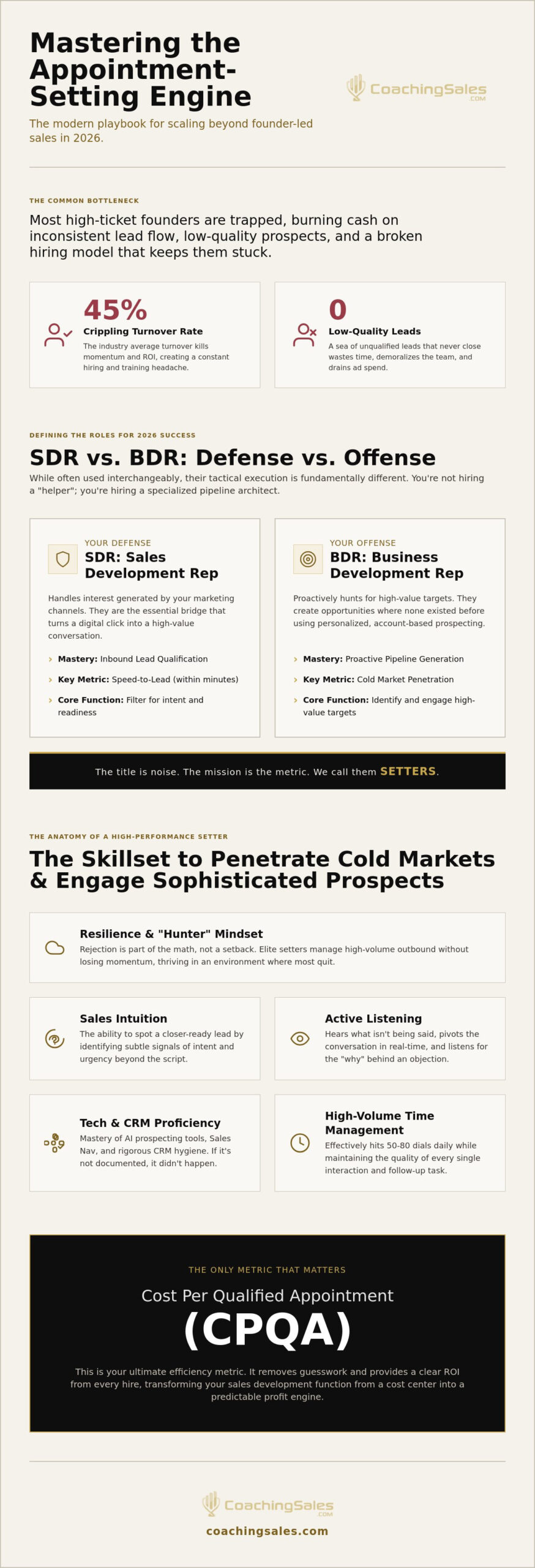
The title on the business card is noise; the only metric that matters is the number of qualified appointments hitting your calendar every Monday morning. Most high-ticket founders are currently burning cash on a 45% turnover rate and a sea of low-quality leads that never close. You've likely felt the sting of inconsistent lead flow and the headache of trying to figure out a compensation structure that actually drives behavior. It's a common bottleneck that keeps ambitious companies stuck in the mud.
This resource is your roadmap to mastering the sdr/bdr function and building a world-class appointment-setting engine. We'll strip away the industry fluff and focus on the practical realities of scaling in 2026. You'll learn the precise skill sets required for high-ticket outreach, how to implement performance frameworks that ensure a clear ROI, and the exact steps to create a scalable hiring system. We are moving past the phase of simply hiring a body and entering the era of building a predictable, high-impact sales machine.
Key Takeaways
- Identify the functional difference between an sdr/bdr to ensure your hiring strategy aligns with your lead generation source.
- Master the transition from founder-led outreach to a scalable team using proven multi-channel cadences and high-ticket playbooks.
- Focus on Cost Per Qualified Appointment (CPQA) as your ultimate efficiency metric to drive clear ROI from every hire.
- Prioritize high-level communication and resilience over rigid scripts to penetrate cold markets and engage sophisticated prospects.
- Build a robust infrastructure that removes guesswork from the sales development process and eliminates the high-turnover trap.
SDR vs. BDR: Defining the Roles for 2026 High-Ticket Success
Corporate titles are often a distraction. In the high-ticket world, the only thing that matters is the outcome: a booked call with a qualified prospect. To build a scalable engine, you must understand the functional difference between an sdr/bdr. While the industry often uses these terms interchangeably, their tactical execution is fundamentally different. Sales development as a discipline has evolved. You aren't just hiring a “helper” for your closers; you're hiring a specialized architect for your pipeline.
In high-growth environments, the lines between these roles are blurring. High-ticket businesses can't afford to let an inbound lead sit, nor can they survive without a proactive outbound strategy. At Coaching Sales, we prefer the term “Setter” over traditional corporate labels. It's results-oriented. It removes the fluff and focuses on the mission: setting the appointment. Whether they are responding to a lead magnet or cold-calling a targeted list, the objective remains the same. If they don't set the meeting, the engine stalls.
The SDR: Mastering the Inbound Qualified Lead
The SDR is your defense. They handle the interest generated by your marketing channels. In 2026, speed to lead is the only metric that guarantees a high show rate. If a prospect downloads a case study or fills out a form, your SDR needs to be in their inbox or on their phone within minutes. Waiting an hour is a death sentence for the conversion. Their job is to filter for intent rather than just budget. Can this person be helped? Are they ready to move now? They are the essential bridge that turns a digital click into a high-value conversation for your closer.
The BDR: Proactive Pipeline Generation
The BDR is your offense. They don't wait for the phone to ring. They hunt. In a high-ticket context, this means account-based prospecting. They identify high-value targets and use personalization at scale to break through the noise. Cold outreach today must feel warm. This requires identifying trigger events, such as a company's recent expansion or a specific market shift, that signal a high-value opportunity. Their goal is cold market penetration. They create opportunities where none existed before, ensuring your growth isn't solely dependent on your current ad spend.
The Anatomy of a High-Performance Appointment Setter
High-ticket outreach requires a level of sophistication that basic SaaS training doesn't cover. You aren't selling a low-cost subscription; you're selling a high-impact transformation. This demands an sdr/bdr who can operate at a peer-to-peer level with CEOs and high-level decision makers. If your team relies solely on a rigid script, they'll be dismissed in the first thirty seconds of a call. High-performers move beyond the script to engage in genuine business conversations. They understand the prospect's pain better than the prospect does. They don't just pitch; they diagnose.
Resilience is the backbone of this role. With an average industry turnover rate of 45%, you must hire for the “Hunter” mindset from day one. Rejection isn't a setback; it's simply part of the math. An elite setter manages the high volume of outbound rejection without losing an ounce of momentum. They also maintain rigorous CRM hygiene. If it isn't documented, it didn't happen. They manage multi-channel cadences across phone, email, and social touchpoints with surgical precision. This level of technical proficiency ensures no lead falls through the cracks.
Soft Skills: The Hidden Drivers of ROI
Active listening is the difference between a booked call and a wasted lead. A high-performance setter hears what isn't being said and pivots the conversation in real-time. They don't just wait for their turn to speak; they listen for the “why” behind the objection. They also master time management in high-volume environments. They ensure they hit their 50 to 80 daily dials while maintaining the quality of every interaction. Sales Intuition is the ability to spot a closer-ready lead by identifying subtle signals of intent and urgency. If you want to stop guessing and start scaling, look at our Setter Program to see how we build these engines.
Technical Skills: The 2026 Sales Tech Stack
Technical proficiency is no longer optional. Setters must master AI-assisted prospecting tools to handle research and first-touch outreach. This frees them to focus on the complex qualification that AI can't replicate. They utilize LinkedIn Sales Navigator and advanced Boolean search techniques to find decision-makers hiding in plain sight. They prioritize data-driven decision making to disqualify leads fast. Every minute spent on a dead-end lead is a minute stolen from a high-value opportunity. Efficiency is the only way to hit the median pipeline generation of $3 million annually that top organizations expect.
Metrics That Matter: Tracking SDR/BDR ROI in High-Ticket Environments
Activity is a vanity metric; revenue is the only signal that matters. Many sales leaders fall into the trap of tracking dials and emails as if they are the end goal. They aren't. While a standard outbound sdr/bdr should hit 50 to 80 dials and 30 to 50 emails daily, these numbers don't guarantee a single cent of revenue. High-ticket scaling requires you to pivot your focus from activity metrics to outcome metrics. If your team is busy but your closers' calendars are empty, you don't have a sales development problem; you have a measurement problem.
Cost Per Qualified Appointment (CPQA) is the ultimate efficiency metric for high-ticket operations. To calculate it, divide your total sales development costs by the number of appointments that actually meet your qualification criteria. This forces you to look at the quality of the “set” rather than the volume. In US B2B SaaS, the median representative generates $3 million in pipeline annually, while top performers in the 10% bracket generate between $5 million and $8 million. If your current engine isn't hitting these benchmarks, your infrastructure is likely leaking cash. To build a precise dashboard around these outcomes, review the setter performance metrics that actually drive profit and identify exactly where your team is leaving revenue on the table.
The 2026 Performance-Based Compensation Model
Modern compensation must prioritize quality over quantity. A standard base salary for an sdr/bdr currently ranges from $50,000 to $68,000, but the real magic happens in the commission structure. You should utilize a hybrid model: a base for stability, a commission per qualified set to drive activity, and a smaller commission per close to ensure the representative qualifies for intent. Implement clawbacks for appointments that don't show or are clearly outside of your target profile. This prevents “calendar stuffing” and aligns the setter's incentives with the closer's success. To engineer a pay plan that attracts A-players without bloating your payroll, study the appointment setter commission structure that top high-ticket teams use in 2026 to drive predictable cost-per-acquisition.
Leading Indicators of SDR Success
The fortune is in the follow-up. Research shows that the majority of high-ticket wins occur between the 5th and 12th touchpoint, yet many entry-level reps quit after two. Track your cadence completion rates to ensure your team is actually finishing the sequences you've built. Monitor your show rates closely; the industry average is between 70% and 80%, but elite teams push for 85% to 90%. If your show rate is low, it's a sign that your setters aren't selling the “value of the meeting” effectively during the initial outreach. Use your CRM data to identify where prospects are dropping off and optimize those specific touchpoints immediately.
Building the Infrastructure: Cadences, Scripts, and CRM Management
Scaling a high-ticket offer without a playbook is a recipe for expensive chaos. You cannot rely on raw talent or “hustle” to carry your growth. A world-class sdr/bdr engine requires a rigid, repeatable infrastructure. This begins with a multi-channel cadence that integrates phone, email, and social touchpoints. If your team only uses one channel, they are invisible to a significant portion of your market. Your CRM must be the absolute source of truth. Every interaction, every objection, and every follow-up date must be documented. Lead leakage happens when systems are optional. In a high-performance environment, systems are mandatory.
Consistency is the only way to measure what's actually working. When every representative is “doing their own thing,” you can't optimize. You need a centralized repository for your best-performing scripts and email templates. This allows you to identify which specific touchpoints are driving appointments and which are falling flat. Without this data, you're just guessing with your marketing budget. Build the engine first. Then, and only then, do you pour on the fuel.
Designing the 12-Touch High-Ticket Cadence
Effective outreach is a marathon. However, the first 24 hours require a multi-touch blitz to establish presence. Start with a phone call, followed immediately by a personalized email and a LinkedIn connection request. Use video messages to break through the noise of a crowded inbox. A short video showing you've done your research carries more weight than twenty generic templates. It proves you aren't a bot. For those looking to optimize their team's output, check out our guide on High Ticket Sales Coaching to maximize your human capital.
Scripting Frameworks That Convert
Stop sounding like a telemarketer. Your scripts should position your team as consultants, not beggars. Use a “Problem-First” approach. Instead of pitching features, lead with the specific pain points your prospect is likely facing. When they throw up smoke screens like “I'm busy” or “Send me an email,” your team must be trained to pivot. These aren't rejections; they are tests of authority. Once the lead is qualified and the value of the meeting is established, the handoff from an sdr/bdr to a Done For You Sales Closer must be seamless. If you need a battle-tested system to run this outreach, explore our Sales Playbooks today.
Transitioning from Founder-Led Prospecting to a Scalable Team
If you are the only person in your company capable of booking a high-ticket meeting, your growth is capped by your own calendar. This is the Founder Trap. You are likely spending hours every week on manual outreach when you should be focused on systems architecture and market expansion. High-ticket scaling demands that you delegate the front end of your sales process to a specialized sdr/bdr team. This isn't just about offloading work; it's about building a predictable revenue engine that functions without your direct involvement. You don't have a business until the lead flow is independent of the founder's effort.
Scaling without chaos requires a shift in mindset. You are no longer the primary hunter; you are the architect of the hunt. This transition is often the most difficult phase for high-performers who are used to doing everything themselves. However, the math is simple. If your time is worth $1,000 an hour, every hour you spend prospecting is a massive net loss for the company. Hire for the role, build the system, and get out of the way.
When to Hire Your First Prospector
Most founders wait far too long to hire their first setter. If you have a validated offer and a clear understanding of your target prospect, you should have hired yesterday. Don't wait for “too many leads.” Hire when you need to reclaim your time to focus on $10,000-per-hour tasks. The ROI of getting the founder off the phones is immediate. When interviewing, look for “Role-Fit” over “Culture-Fit.” You need a hunter with the resilience to handle 80 dials a day, not just a friendly personality. The first 90 days are critical; if they aren't hitting activity benchmarks by week four, they aren't the right fit for a high-ticket environment.
The Coaching Sales Blueprint for Elite Teams
Building an elite team requires a proven recruiting pipeline. You can't rely on generic job boards to find A-players who understand high-ticket nuances. The Coaching Sales Setter Program is designed to solve this exact problem. We source, vet, and place high-performance setters who are trained to hit the ground running. We don't just “fill a seat.” We provide the custom Sales Playbooks required for $10M+ scale, ensuring your new sdr/bdr hires have a roadmap for success from day one. Recruiting is a continuous process of optimization, not a one-time event. You must always be sourcing talent to ensure your engine never stalls. If you want to scale to eight figures, you need a recruiting system that is as robust as your sales system.
Build Your High-Ticket Appointment Engine Today
You now have the roadmap to move from operational involvement to true leadership. Scaling a high-ticket offer requires more than just hiring a body; it requires an architecture built on high-level communication and rigorous CRM hygiene. Stop measuring vanity dials and start tracking your Cost Per Qualified Appointment. If your infrastructure isn't ready for a professional sdr/bdr team, you're simply burning capital in a high-turnover market. Transitioning away from founder-led outreach is the only way to reclaim your time and achieve eight-figure scale.
We specialize in offers ranging from $10k to $100k+ and have already placed over 500 high-ticket sales professionals into high-growth environments. Our proprietary Setter Program training turns raw talent into elite revenue engines who understand the nuances of high-value prospecting. You don't have to build this from scratch or risk expensive hiring mistakes. Scale your high-ticket team with the Coaching Sales Setter Program and turn your outreach into a predictable, scalable machine. The era of guessing is over. It's time to build your engine.
Frequently Asked Questions
What is the difference between an SDR and a BDR?
The functional difference lies in the source of the prospect. An SDR (Sales Development Representative) qualifies inbound interest from your marketing funnels, while a BDR (Business Development Representative) focuses on outbound hunting and cold market penetration. In high-ticket environments, these roles often merge into a single “Setter” function. The goal remains the same: identify qualified prospects and move them onto a closer's calendar.
How much should I pay an SDR/BDR in 2026?
Current 2026 industry standards show a base salary between $50,000 and $68,000 for an sdr/bdr. Total on-target earnings (OTE) typically range from $65,000 to $95,000 once commissions are factored in. Outbound-focused BDRs often command a slight premium of $3,000 to $8,000 over their inbound counterparts. Top performers in enterprise environments can exceed $110,000 in annual earnings.
Should my SDRs report to Marketing or Sales?
Direct reporting to Sales or Revenue Operations (RevOps) is the most effective model for high-ticket scaling. When they report to Marketing, the focus often shifts toward lead volume rather than lead quality. Sales leadership ensures the team stays aligned with the closers' requirements. This alignment prevents “junk” appointments from cluttering your calendar and ensures every “set” has a high probability of closing.
Can I hire a commission-only SDR for my high-ticket offer?
You can, but it's a high-risk strategy that only works with a proven, high-volume offer. Elite sales professionals generally demand a base salary for stability. If you opt for a commission-only model, your commission per qualified appointment must be significantly higher than market averages to attract A-players. Most businesses find that a hybrid model with a base salary produces much lower turnover and higher long-term ROI.
How many dials should an SDR make per day?
An outbound sdr/bdr should aim for 50 to 80 dials and 30 to 50 emails every single day. This volume is the baseline required to generate 12 to 15 qualified meetings per month. While quality is critical, sales development is still a numbers game. You cannot optimize a process that lacks sufficient activity. High volume creates the data set you need to refine your scripts and cadences.
What is a good conversion rate from set to close in high-ticket sales?
A healthy conversion rate from a qualified set to a closed deal typically falls between 20% and 30%. If your rate is lower, you likely have a qualification problem at the front end or a skill gap at the closing stage. Monitor your show rate as well; top teams achieve an 85% to 90% show rate. If prospects aren't showing up, your setters aren't selling the value of the meeting.
Do I need a BDR if I have plenty of inbound leads?
Yes, because inbound lead flow is reactive and often fluctuates with ad spend. A BDR allows you to proactively target “whale” accounts that may never click on a Facebook ad or download a whitepaper. Outbound hunting gives you total control over your pipeline growth. Relying solely on inbound leaves your business vulnerable to platform changes and rising customer acquisition costs.
How long does it take to ramp up a new SDR/BDR?
The standard ramp-up period is 90 days. During the first 30 days, focus on product knowledge and shadowing calls. By day 60, the representative should be hitting full activity targets for dials and emails. By day 90, they should be consistently hitting their quota for booked and qualified appointments. If they aren't quota-ready by the end of month three, you likely have a hiring or training mismatch.