

Your appointment setter booked 30 meetings this month, yet your revenue hasn't budged. That isn't a performance win; it's a resource drain. You're likely tired of seeing a “full” calendar only to have half the prospects ghost or fail to qualify. It's frustrating to manage high lead volume while your closers complain about “junk” calls. You need a way to see past the noise and identify which setter performance metrics actually drive profit.
We're going to fix that. This guide provides the exact KPIs required to evaluate your team and turn your sales calendar into a high-yield revenue engine. You'll learn why a 65% to 80% show rate is the new gold standard and how to track pipeline dollars generated rather than just booking volume. We're moving beyond the basics to give you a clear dashboard for predictable growth. It's time to stop guessing and start scaling with precision. We will break down the “Core 5” metrics so you can finally distinguish your A-players from your liabilities and build a front-end system that actually scales.
Key Takeaways
- Learn how to distinguish between vanity activity and revenue-driving setter performance metrics to ensure every action moves the needle.
- Identify the “Core 5” metrics that reveal the true health of your high-ticket outreach, from total touchpoints to positive response rates.
- Uncover the efficiency ratios that pinpoint exactly where your funnel is leaking, allowing you to fix broken hooks and weak closing frameworks.
- Establish a high-performance management rhythm using daily tracking dashboards and weekly audits to maintain an elite standard of quality.
- Discover how to scale your sales infrastructure using proven playbooks and dedicated programs that maximize your calendar capacity.
Defining Setter Performance Metrics: Activity vs. Outcomes
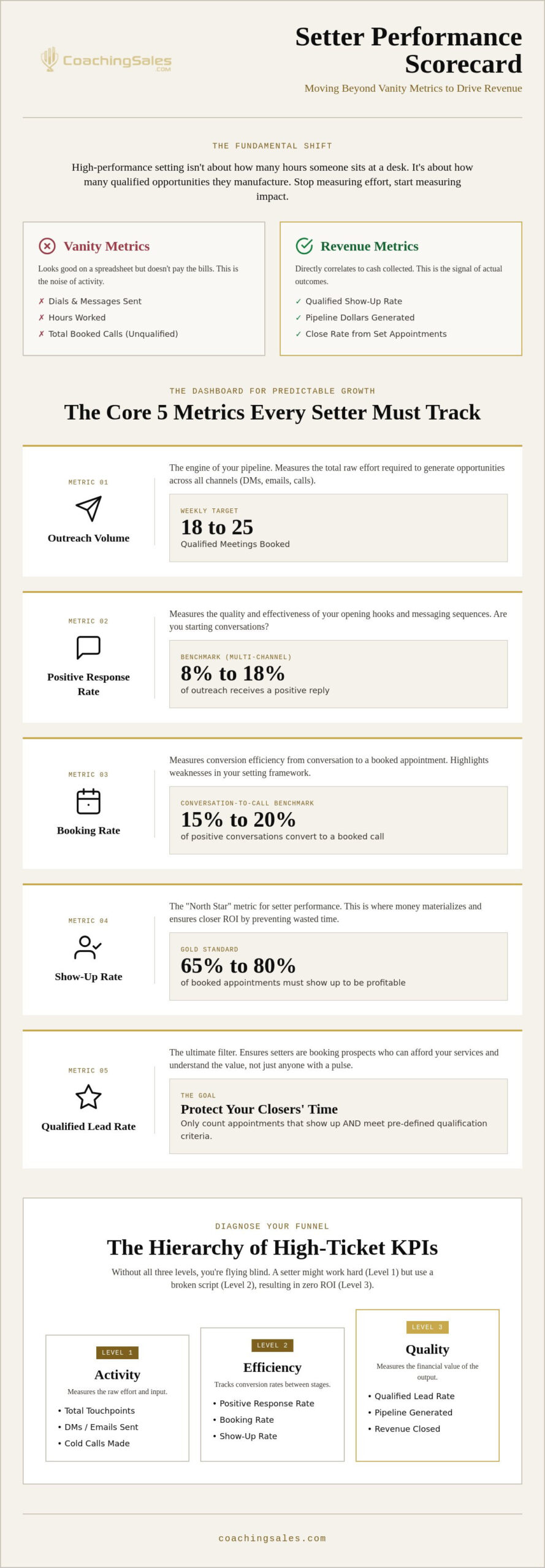
Stop measuring effort and start measuring impact. In the high-ticket world, setter performance metrics are the quantitative data points used to evaluate an appointment setter's efficiency. Most founders make the mistake of tracking everything. They get lost in a sea of data that doesn't actually correlate to cash collected. If you want a team that scales, you must distinguish between the noise of activity and the signal of outcomes. High-performance setting isn't about how many hours someone sits at a desk. It's about how many qualified opportunities they manufacture.
You probably track dials and messages. These are ‘Vanity Metrics.' They look good on a spreadsheet but don't pay the bills. If a setter sends 500 messages but books zero calls, their activity level is high, but their performance is zero. Conversely, ‘Revenue Metrics' focus on qualified calls and show-ups. To build a high-yield sales machine, you need a clear hierarchy for your Key Performance Indicators (KPIs). This structure allows you to see exactly where your funnel is failing before it hits your bank account.
The Hierarchy of High-Ticket KPIs
Think of your metrics in three distinct tiers. Level 1 is Activity. This measures the raw effort required to generate opportunities. It includes total outbound touchpoints across all channels. Level 2 is Efficiency. This tracks the conversion rate between stages. Are your hooks landing? Are your conversations moving toward a booking? Level 3 is Quality. This is the financial value of the output. It measures if the setter is finding the right people. Without all three levels, you're flying blind. You might have a setter who works hard (Level 1) but uses a broken script (Level 2), resulting in zero ROI (Level 3).
Why ‘Booked Calls' is a Dangerous Metric
Relying on ‘Booked Calls' as your primary KPI is a recipe for disaster. It creates a perverse incentive. If you pay a setter for every call they put on the calendar, they'll book anyone with a pulse. Your closers end up spending their day talking to tire-kickers who can't afford your services or don't understand the value. This leads to closer burnout and massive revenue leaks. Every hour your closer wastes on a no-show or a bad fit is an hour they aren't closing a five-figure deal. You aren't just losing the commission; you're losing the opportunity cost of a real prospect.
The Qualified Show-Up Rate is the only metric that guarantees closer ROI because it filters out the noise and focuses exclusively on high-intent prospects who actually appear for the call. If your setter performance metrics don't prioritize this “North Star,” you're incentivizing your team to sabotage your sales department. Stop rewarding the booking. Start rewarding the qualified appearance. This shift in focus is what separates a chaotic startup from a predictable $10M+ revenue engine. Building that engine requires more than just tracking the right numbers — it demands a fully systematized high ticket sales ecosystem that operates independently of your personal involvement.
The Core 5 Metrics Every High-Ticket Setter Must Track
Success in high-ticket sales isn't a mystery. It's math. To master your setter performance metrics, you must track five specific pillars that determine your revenue trajectory. If you ignore these, you're essentially gambling with your marketing budget. High-performers don't guess. They use data to dictate their next move. Start by tracking these five core data points daily.
- Outreach Volume: This is your engine. It counts every DM, email, and cold call. A full-time setter should aim for enough volume to secure 18 to 25 meetings per week.
- Positive Response Rate: This measures the quality of your hooks. Multi-channel sequences typically see an 8% to 18% response rate, far outperforming single-channel efforts.
- Booking Rate: This is your conversion efficiency. A benchmark of 15% to 20% for the call-to-appointment rate is considered good in most high-ticket environments.
- Show-Up Rate: This is where the money starts to materialize. Your target show rate for appointments must sit between 65% and 80% to maintain a healthy ROI.
- Qualified Lead Rate: This is the ultimate filter. It ensures your closers only speak with prospects who can actually buy.
Measuring Outreach Efficiency
You need to know exactly where your funnel is leaking. Calculate your ‘Conversation-to-Call' ratio to spot script weaknesses immediately. If your setters are having plenty of chats but no one is booking, your framework is broken. Benchmarks matter here. Cold calling alone often yields a 1% to 5% conversion, while LinkedIn usually hovers between 2% and 6%. To stabilize these numbers, you must implement standardized Sales Playbooks. These assets ensure every outreach attempt maintains a high standard of quality. Many elite teams also integrate the SPIN selling technique to build trust during the initial touchpoint. If you find your team is struggling to hit these benchmarks, it might be time to look into a professional Setter Program to refine their approach.
The ‘Qualified' Filter: Protecting Your Closers
A full calendar is worthless if it's packed with “junk” leads. You must define clear qualification criteria based on Budget, Authority, Need, and Timing (BANT). This protects your closers from wasting hours on “no-fit” calls. Establish a tight feedback loop where closers report back to setters on lead quality after every call. This constant communication allows for real-time adjustments to the targeting strategy. A 70%+ qualified rate is the benchmark for elite setters who truly understand their Ideal Client Profile.
Efficiency Ratios: Identifying the Leaks in Your Funnel
Raw numbers tell you the volume. Ratios tell you the truth. If you want to optimize your setter performance metrics, you must look at the conversion points between each stage of the funnel. A leak at any point in this sequence compounds into massive revenue loss. Analyzing your Essential Sales Performance Metrics through the lens of efficiency ratios allows you to identify exactly where your revenue is leaking. It turns a “bad month” from a mystery into a solvable math problem.
Start with the Outreach-to-Conversation ratio. If this is low, your hook is weak or your targeting is off. Next, look at the Conversation-to-Booked ratio. This measures if your setting framework is persuasive enough to move a prospect from a chat to a calendar event. The Booked-to-Show ratio then reveals the strength of your pre-call indoctrination. Finally, the Show-to-Close ratio tells you if the setter is sending the right people. If your closers can't close the leads, the setter is likely prioritizing volume over qualification. Understanding how your SDR/BDR function fits into this outreach framework is essential for diagnosing which stage of the funnel is underperforming.
Diagnosing Low Show-Up Rates
A low show-up rate is rarely just a “reminder” problem. It's usually a value problem. Prospects don't skip calls they believe are worth five or six figures. They skip calls that feel like a generic sales pitch. If your show-up rate is below 65%, your setters might be over-promising to hit a booking quota. This creates a psychological disconnect where the prospect agrees to the call just to end the conversation but has no intention of attending. Implement a double-confirmation system where the setter sends a personalized video or a specific “homework” asset 24 hours before the call. This reinforces the value and filters out low-intent leads before they waste your closer's time.
Setter Performance Benchmarks for 2026
Benchmarks vary significantly based on lead source. Inbound leads should convert at much higher rates than cold outbound touches. However, elite setters maintain high standards regardless of the channel. If your current team isn't hitting these marks, you likely have a talent or training gap that needs immediate attention. You can find pre-vetted A-players through our High Ticket Sales Recruiting service to ensure your front-end is handled by experts.
| Metric Ratio | Average Performance | Elite Performance |
|---|---|---|
| Outreach-to-Conversation | 5% – 7% | 15% – 20% |
| Conversation-to-Booked | 8% – 10% | 15% – 25% |
| Booked-to-Show | 40% – 50% | 70% – 85% |
| Show-to-Qualified | 30% – 40% | 55% – 75% |
Elite setter performance metrics are the result of a disciplined process. If you're seeing average numbers, it's time to audit your scripts and qualification filters. Don't settle for a leaky funnel when the data shows what is possible.
How to Manage and Optimize Setter Performance
Data without management is just a history lesson. To move the needle on your setter performance metrics, you must implement a rigorous optimization cycle. It starts with absolute visibility. You cannot manage what you do not measure in real-time. If you aren't looking at your dashboard daily, you aren't leading; you're just hoping. Follow these five steps to transform raw data into a high-performance culture.
- Step 1: Implement a daily tracking sheet or CRM dashboard. Real-time visibility allows you to spot a slump at 10:00 AM rather than at the end of the month.
- Step 2: Conduct weekly ‘Call/DM Audits.' Review the actual interactions to ensure your brand voice remains elite.
- Step 3: Identify the ‘bottleneck' metric for each setter. One setter might struggle with the initial hook, while another fails to bridge to the booking.
- Step 4: Use role-play and script refinement. Target the specific bottleneck identified in step 3 rather than giving generic advice.
- Step 5: Tie commission structures to ‘Qualified Show-Ups.' Incentivize the outcome that actually generates revenue, not just the activity of filling a calendar. To engineer this correctly, you need a proven appointment setter commission structure that rewards quality over raw volume while protecting your margins.
The Weekly Performance Review Framework
Efficiency is the goal of management. You don't need hour-long meetings to drive results. A 15-minute audit is enough to pivot a setter's trajectory. During this review, every setter must answer three questions: What is my current bottleneck? What was my biggest win this week? What is my one specific adjustment for next week? This forces ownership of their own setter performance metrics. To streamline this, many high-growth firms use automated Sales Team KPI Tracking. This keeps the focus on the math and removes the emotion from performance evaluations.
Fixing the ‘Burnout' Bottleneck
Low activity isn't always a skill issue. Sometimes it's a structural failure. High-volume setting is mentally taxing. You must recognize when a dip in volume is a burnout issue versus a lack of discipline. Restructure the setter's day into deep-work blocks. Instead of “checking DMs” all day, have them execute 90-minute sprints of pure outreach followed by recovery periods. Energy management is the unseen variable that dictates whether a setter hits 100 touchpoints or collapses at 40. If your current team is consistently hitting a wall, it may be time to bring in fresh talent through our Sales Recruiting services to maintain your momentum.
Managing an elite team requires a blend of high-level systems and human psychology. When you align your incentives with qualified show-ups, you turn your setters into profit-driven partners. This is how you transition from an operator to a true leader in your industry.
Scaling Your Setter Team with Coaching Sales
Founders fail to scale because they treat appointment setting as an art rather than a machine. If you're still the one checking DMs every morning or micromanaging every outreach attempt, you're the bottleneck. You can't build a $10M+ company on the back of founder-led effort. You need a managed department that operates with clinical precision. Transitioning from a one-man show to a high-performance team requires more than just hiring a body; it requires a proven architecture for success. Understanding the full high ticket sales ecosystem infrastructure needed for $10M+ scale is the critical first step in making that transition successfully.
Our Setter Program provides that roadmap. We don't just give you a list of names. We provide the infrastructure to ensure those names produce results. Elite setters don't just “work hard.” They obsess over the setter performance metrics that actually move the needle. By placing and training setters who already understand how to manage their own KPIs, we remove the operational burden from your shoulders. You move from being the chief reminder officer to a true visionary leader.
Done-For-You Setter Infrastructure
Guesswork is the enemy of scale. Our custom Sales Playbooks remove the variables by standardizing every interaction. When your team follows a battle-tested framework, your setter performance metrics become predictable rather than erratic. Think about the ROI of hiring a pre-vetted setter versus training a “green” rep from scratch. A raw hire can take three to six months to ramp up, costing you tens of thousands in lost opportunities. A pre-vetted A-player hits the ground running in days. To attract those A-players, you must offer a competitive appointment setter commission structure built for high-ticket performance that top-tier talent won't walk away from. To complete your revenue ecosystem, you can pair these setters with our Done For You Sales Closers, ensuring every qualified lead is handled by a professional closer.
Next Steps: Auditing Your Current Performance
The marketplace in 2026 doesn't tolerate mediocrity. If your show-up rates are lagging or your calendar is filled with junk, your current system is broken. You need a sophisticated approach to appointment setting that prioritizes qualified density over raw volume. It's time to face the math. Are your setters an asset or a liability? Are they manufacturing revenue or just burning leads?
Stop guessing about your team's potential. We offer a comprehensive audit of your current sales team's performance to identify the exact leaks in your funnel. We will look at your ratios, your scripts, and your management rhythm to show you exactly where you're leaving money on the table. Don't wait for another month of stagnant growth. Book a consultation today and let's build the high-yield revenue engine your business deserves.
Master Your Front-End Revenue Engine
The difference between a stagnant business and a $10M+ scale is the precision of your front-end systems. You now have the framework to move beyond vanity numbers. Stop rewarding activity and start demanding outcomes. By focusing on the right setter performance metrics, you turn your sales department into a predictable profit center. You've seen the gold-standard benchmarks. You know exactly where your funnel leaks. Now, it's time to execute with absolute certainty. The 2026 marketplace has no room for “junk” appointments or ghosted calls.
Building an elite team shouldn't be a trial-and-error experiment that drains your capital. You need vetted talent and battle-tested infrastructure to maintain maximum calendar density every single week. We provide the roadmap to transition from founder-led chaos to a managed, high-performing department. It's time to Scale your sales team with our elite Setter Program. We deliver vetted high-performance setters and custom Sales Playbooks designed for $10M+ scale. Our no-nonsense, results-oriented training ensures your team hits their targets from day one. You have the tools to dominate your market. Take the lead and build the high-yield future of your business today.
Frequently Asked Questions
What is a good show-up rate for high-ticket appointment setters?
A target show-up rate for high-ticket environments sits between 65% and 80%. If your rate falls below this threshold, it typically indicates a lack of pre-call indoctrination or that the setter is over-promising to hit a booking quota. Maintaining this benchmark ensures your closers spend their time on high-intent prospects rather than empty calendar slots.
How many outbound DMs should a setter send per day?
A full-time setter should execute enough daily touchpoints to secure 18 to 25 meetings per week. While the exact number of DMs varies by platform and niche, most high-ticket setters find that 50 to 100 high-quality, personalized messages per day are necessary to maintain a dense calendar. Quality must always precede quantity to avoid burning your lead list or getting flagged by social platforms.
Should I pay my setters for every booked call or only for show-ups?
You should always tie commission structures to qualified show-ups rather than raw booked calls. Paying for bookings alone incentivizes setters to push unqualified prospects onto the calendar just to collect a fee. When you reward the qualified appearance, you align the setter's goals with the closer's success and the company's overall revenue growth.
What is the difference between an SDR, a BDR, and an Appointment Setter?
An appointment setter focuses purely on the mechanics of booking meetings, while Sales Development Reps (SDRs) often handle initial discovery and Business Development Reps (BDRs) focus on outbound prospecting. In high-ticket environments, these roles often overlap. However, the setter's primary objective is always calendar density and ensuring the front-end of the funnel remains consistently full of qualified opportunities. For a deeper breakdown of how these roles function within a high-ticket outreach system, see our complete SDR/BDR resource guide for scaling high-ticket outreach.
How do I track setter performance if I don't have a complex CRM?
You can effectively track setter performance metrics using a simple daily tracking sheet or a shared spreadsheet if you lack a complex CRM. The key is manual discipline; every touchpoint, conversation, and booking must be logged in real-time. This visibility allows you to calculate essential efficiency ratios and identify bottlenecks without needing a sophisticated software stack to start.
What is the most important KPI for a high-ticket sales setter?
The Qualified Show-Up Rate is the “North Star” metric because it is the only KPI that directly guarantees closer ROI. While volume and bookings matter, they are secondary to the number of ideal prospects who actually appear for their scheduled calls. Mastering this specific data point allows you to evaluate your setter performance metrics with absolute clarity and precision.
How long does it take for a new setter to hit their performance benchmarks?
A new setter typically requires two to four weeks of active setting to hit their full performance benchmarks. This ramp-up period allows them to internalize your Sales Playbooks and refine their objection handling within your specific niche. Once they are fully ramped, you should expect a consistent output of 20 to 40 qualified meetings per month depending on your lead flow and outreach channels.
Can a setter also act as a closer in a high-ticket environment?
A setter can act as a closer in smaller operations, but this hybrid model often leads to a “boom and bust” revenue cycle. When the setter is busy closing, they stop prospecting, which eventually causes the calendar to go cold. High-performance teams separate these roles to ensure constant lead flow and specialized focus, allowing each team member to operate at their highest level of efficiency.