

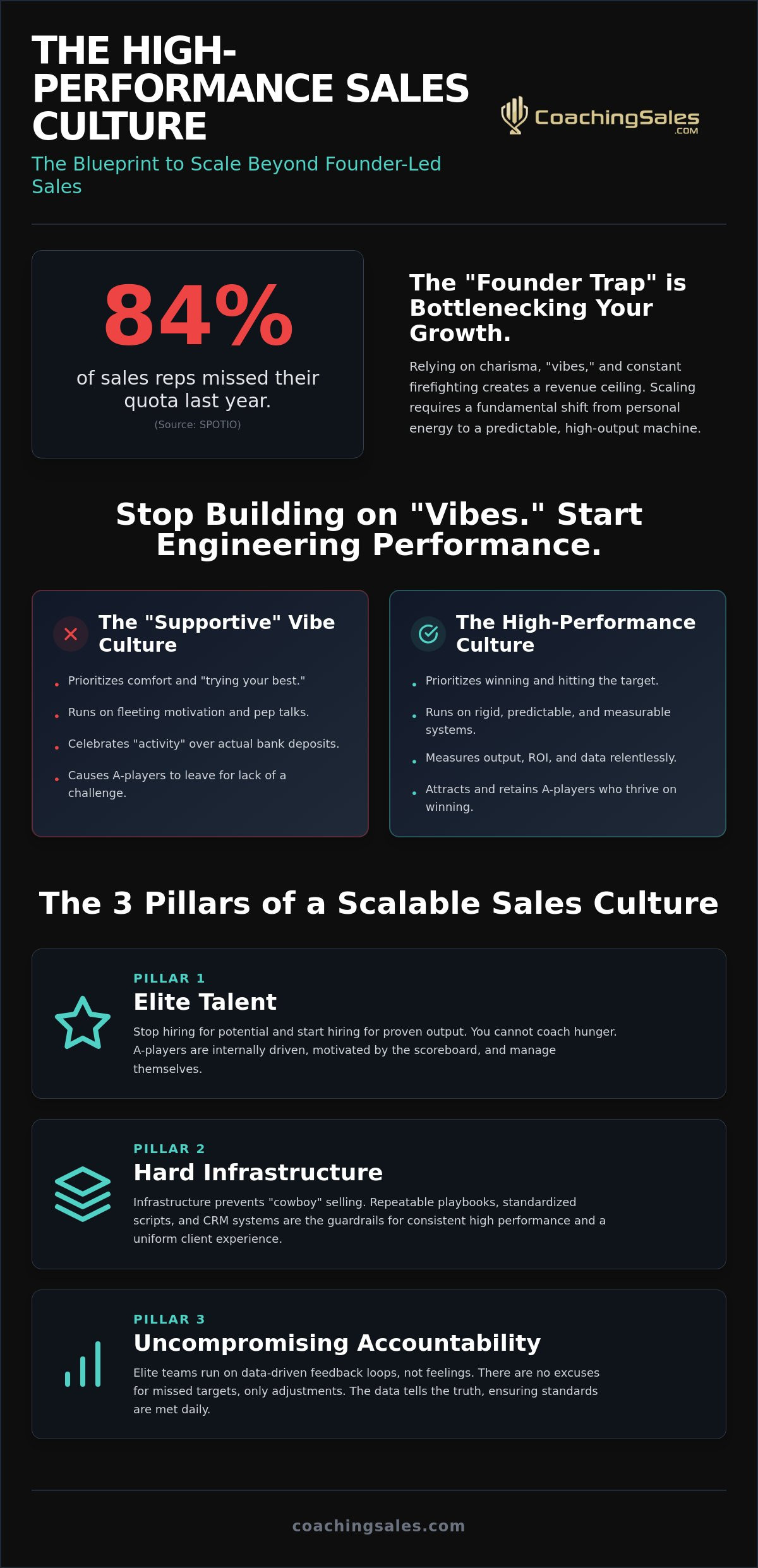
84% of sales representatives missed their quota last year according to data from SPOTIO. This isn't just a streak of bad luck. It's the inevitable result of building a team on “vibes” rather than a high performance sales culture. You know the feeling of watching revenue swing wildly month to month while you're forced to step back into the trenches to save deals. It's exhausting, and it's the primary reason you haven't scaled past the founder-led sales phase.
You've likely realized that even the most “promising” closers will fail if they don't have a rigid system to follow. You're tired of the turnover and the constant need to babysit your reps. This article will show you how to transform your sales team from a loose group of individuals into a high-output revenue engine through elite standards and hard infrastructure. You'll learn the exact blueprint for installing a self-sustaining team of A-players who manage themselves. We'll break down the specific playbooks, recruiting strategies, and coaching rhythms required to build a predictable path to $10M and beyond.
Key Takeaways
- Stop relying on “vibes” and learn how to install a high performance sales culture that runs on rigid, predictable systems.
- Identify the two critical pillars of scaling: sourcing elite talent and building the hard infrastructure required for high-output growth.
- Break the “Founder Trap” by replacing fleeting motivation with repeatable playbooks that ensure your team hits their numbers.
- Follow a five-step roadmap to audit your revenue leaks and establish the non-negotiable standards every rep must meet.
- Learn how to source and place high-ticket closers who manage themselves so you can finally step away from the daily sales grind.
What is a High Performance Sales Culture?
A high performance sales culture is not a mood. It is a system of uncompromising standards and predictable outputs designed to drive revenue. Most founders mistake “culture” for how people feel on a Friday afternoon. They focus on “vibes” because vibes are easy to create. But vibes don't scale. Scaling from $1M to $10M requires you to stop relying on the founder's charisma and start relying on a machine. If your team depends on your personal energy to hit their numbers, you don't have a culture; you have a bottleneck.
High-ticket sales demand a sharp divide between a “supportive” culture and a “performance” culture. A supportive culture prioritizes comfort and “trying your best.” A performance culture prioritizes winning and hitting the target. If your team is more worried about hurting feelings than missing quotas, your growth will stall. To understand the broader context of organizational excellence, one might ask, What is a High Performance Culture? and how does it apply to high-stakes revenue environments? It requires moving past sentiment and toward architectural precision.
Ultimately, a high performance sales culture is the intersection of elite talent and rigorous systems.
The Myth of the “Vibe” vs. The Reality of ROI
Ping-pong tables and beer taps don't close $50k deals. In many cases, they mask a lack of results. Toxic positivity is a silent killer in scaling companies. It's the habit of celebrating “activity” when the bank account is empty. True A-players don't care about office decor. They find their motivation in winning. If the environment is too soft, your best closers will leave for a place where their performance is actually measured and rewarded.
The Core Characteristics of Elite Teams
Elite teams run on radical accountability. There are no excuses for missed targets, only data-driven adjustments. If a rep misses their numbers, the first question isn't how they feel. It's about what the CRM says about their lead-to-close ratio. This creates healthy competition without destructive silos. Top closers possess a “never finished” mindset. They treat every call as a chance to optimize their scripts and refine their process. They don't just work; they engineer revenue.
The 3 Pillars of a Scalable Sales Culture
Scaling to $10M and beyond isn't a matter of effort. It's a matter of structural integrity. A high performance sales culture rests on three non-negotiable pillars that work in tandem to eliminate the founder bottleneck. If one pillar fails, the entire revenue engine stalls. You can't out-hustle a broken system. You need an architecture that supports growth without requiring your constant intervention.
The first pillar is Elite Talent. This means hiring people who don't need a babysitter. The second pillar is Hard Infrastructure. This consists of the playbooks and CRM systems that dictate how the game is played. The third pillar is Uncompromising Accountability. This is the data-driven feedback loop that ensures standards are met every single day. Together, these pillars create a self-correcting ecosystem. When talent meets systems under high accountability, the weak links reveal themselves immediately. The data tells the truth even when the reps don't.
Talent: Why You Can’t Coach a C-Player to A-Player Results
The cost of “settling” for mediocre closers is higher than most founders realize. You spend your time fixing their mistakes instead of growing the business. Elite recruiting is the first step in culture building. You cannot coach hunger into someone. A-players have an internal drive that doesn't rely on your morning pep talks. They are motivated by the scoreboard and the commission check. If you want to scale, you must stop hiring for potential and start hiring for proven output. If your current team feels like a weight, it's time to look into professional Sales Recruiting to upgrade your roster.
Systems: The Guardrails of Performance
Infrastructure is what prevents “cowboy” selling. When every rep uses their own “secret sauce,” you have no way to measure what actually works. Custom Sales Playbooks provide the necessary guardrails. They ensure that every prospect receives the same high-level experience, regardless of which rep takes the call. This is how you maintain brand authority at scale. For a broader perspective on the foundational elements of a winning team, research How to Build a Sales Culture to see how elite organizations structure their daily operations.
Standardized scripts aren't about making reps sound like robots. They're about providing a proven path to the close. When you have a system, you can diagnose exactly where a deal went sideways. Was it the discovery? Was it the objection handling? Without infrastructure, you're just guessing. Systems allow you to scale without losing quality control because the process remains the same even as the team grows from three reps to thirty. If you're looking for an enterprise sales execution platform that helps your team implement company strategies on every deal, click here.
Infrastructure Over Inspiration: Why Playbooks Beat Pep Talks
Motivation is a drug. It feels great for an hour, then it wears off. If your team relies on Monday morning pep talks to hit their numbers, you're building on sand. Infrastructure is the concrete. It doesn't care how a rep feels. It ensures they follow the process regardless of their mood. This shift from emotional management to structural management is the hallmark of a high performance sales culture. You stop managing people and start managing the process.
Most founders fall into the “Founder Trap.” You're likely the best closer in the building. You use intuition and charisma to win deals. But you can't clone your personality. When you try to scale, your team fails because they don't have your decade of context. They need a roadmap, not a speech. A centralized sales playbook removes the guessing game from the sales floor. It gives reps the confidence to lead calls because the answers are already written down. When you provide Done For You Sales Closers with a proven roadmap, they hit the ground running. They don't need to reinvent the wheel. They just need to drive the car you built.
The Anatomy of a High-Performance Sales Playbook
A playbook isn't a dusty PDF. It's a living document that dictates every movement. First, it defines your Ideal Client Profile (ICP) with surgical precision. If the team doesn't know exactly who they're talking to, they waste time on low-intent leads. Second, it provides a rigid Standard Operating Procedure (SOP) for follow-up and objection handling. There's no room for “freestyling.” Finally, it tracks the right data. Stop obsessing over lagging indicators like monthly revenue. Focus on leading indicators: outbound calls made, discovery sessions booked, and follow-up speed. If the leading indicators are healthy, the revenue takes care of itself.
Removing the Founder from the Sales Equation
Your culture suffers when you're the only one who can close. It creates a ceiling on your growth and a dependency that kills enterprise value. You must build a “plug-and-play” environment. This means a new hire should be able to step in and see exactly how to win. This is the transition from “Art” to “Science.” Art is beautiful, but it's unique and hard to replicate. Science is repeatable. It's predictable. If you want to scale to $10M, you need a laboratory, not an art gallery. High-output teams thrive when the path is clear. Remove the ambiguity, and you'll find that your team's “motivation” problems magically disappear when they finally know exactly how to win.
How to Build a High Performance Sales Culture in 5 Steps
Building a high performance sales culture is a deliberate installation process. It isn't something that happens by accident over happy hour drinks. It requires a sequential roadmap that moves from identifying existing rot to installing elite systems. If you want to scale to $10M, you must follow these five steps with surgical precision. Stop hoping for better results and start engineering them.
- Step 1: Audit your current “Revenue Leaks” and team bottlenecks.
- Step 2: Define your “Non-Negotiables” for performance and behavior.
- Step 3: Recruit for “Character” and “Competence” simultaneously.
- Step 4: Install the infrastructure, specifically Playbooks and CRM rigor.
- Step 5: Implement a “Coach-to-Close” feedback loop.
Step 1: The Brutally Honest Sales Audit
You cannot fix what you don't measure. Most founders look at total revenue and ignore the leaks. A real audit examines actual conversion rates versus “busy work” activity. If your reps are making 100 calls but only booking two discovery sessions, you have a bottleneck. You must also identify the “culture killers” on your team. These are the underperformers or the “brilliant jerks” who think the rules don't apply to them. Firing fast is often the best cultural move you can make because it signals to the rest of the team that your standards are real.
Once the audit is complete, you must define your non-negotiables. These are the minimum standards for CRM hygiene, follow-up speed, and closing ratios. If a rep falls below these marks, there is no debate. They either fix the data or they leave the roster. This clarity removes the emotional weight of management. If you need help identifying these gaps, our Sales coaching can provide an objective external perspective.
Step 5: The Elite Coaching Loop
The final step is the feedback loop. High-output teams treat sales like professional sports. They watch the game film. Use call recordings for objective feedback rather than subjective criticism. Don't tell a rep they “sounded off.” Show them exactly where they lost control of the frame at the 12-minute mark. This is how you move the needle on performance without hurting egos.
Set up daily huddles that focus on two things: “The Win” and “The Lesson.” Every day should provide a data point that makes the team sharper. This is why high ticket sales coaching focuses on human optimization. You aren't just teaching people how to talk; you're teaching them how to think and execute under pressure. When you combine this coaching with the infrastructure mentioned in previous sections, you create a team that doesn't just hit targets but consistently shatters them.
Recruiting for Culture: Sourcing and Placing A-Players
Your high performance sales culture is only as good as your last hire. Culture isn't a plaque on the wall; it's the standard of the people currently on your floor. Every new addition either raises that standard or drags it down. If you hire one mediocre rep, you send a message to your A-players that “average” is now acceptable. You must treat your hiring process with the same intensity as your sales process. You aren't just looking for a body to fill a seat. You're looking for a specific psychological profile.
There's a massive difference between a “job seeker” and a “high-ticket closer.” Job seekers want security, a base salary, and a comfortable environment. Closers want leverage, a scoreboard, and a high-ceiling commission structure. They don't want to be “managed”; they want to be equipped. Specialized firms protect your culture by vetting for this specific drive before you ever see a resume. Professional Sales Recruiting and Placement acts as your ultimate cultural safeguard. It ensures that only those with the requisite hunger and technical skill ever enter your ecosystem.
The Vetting Process for Elite Closers
Testing for coachability is the most critical part of the interview phase. Give a candidate a piece of hard, objective feedback during their first mock call. If they get defensive or make excuses, disqualify them immediately. If they can't take feedback in a controlled interview, they'll never survive a high-pressure closing environment. You must also verify track records with skepticism. Many reps claim “big numbers” while selling for household brands where the brand did the heavy lifting. You need to know if they can actually build value and handle resistance. Implementing a Setter Program is an effective way to build a talent pipeline. It allows you to groom future closers within your own walls, ensuring they're fully indoctrinated into your standards before they ever touch a high-ticket lead.
Onboarding for Immediate Cultural Alignment
The first 90 days set the tone for the rest of a rep's tenure. There is no “grace period” for standards. New hires must be immersed in your sales playbook from day one. They need to see that the roadmap isn't a suggestion; it's the law. This immediate immersion removes the “cowboy” mentality before it can start. The goal of onboarding is the first deal. Closing that first sale validates the entire system for the new hire. It proves that your infrastructure works. Once they see the ROI of following your process, they'll become the biggest advocates for your culture. This is how you scale. You don't just hire people; you install them into a winning machine.
Scale Your Revenue with Architectural Precision
Scaling to $10M isn't a mystery; it's a math problem solved by a high performance sales culture. You've seen that relying on your personal charisma is a dead end that creates a permanent bottleneck. To build a self-sustaining engine, you must install elite talent into a rigid, data-driven infrastructure. Stop managing personalities and start managing the proven roadmap that dictates every move from discovery to close.
We've already placed 500+ elite closers into high-ticket businesses and developed proprietary Sales Playbook frameworks used by $10M+ brands. We specialize exclusively in high-ticket environments, avoiding the low-ticket fluff that fails at scale. If you're ready to transition from the daily sales grind to a true leadership role, the path is clear. Stop babysitting your team and install an elite sales culture today. Your next level of growth is waiting for you to build the machine that supports it. Now is the time to execute.
Frequently Asked Questions
How do you measure sales culture performance?
Measure it by the delta between your top and bottom performers and the consistency of your monthly revenue. A true high performance sales culture has a tight spread where the majority of the team hits quota. If one “hero” rep is carrying 80% of the load, your culture is actually failing; it's a bottleneck disguised as success.
Can you change a toxic sales culture without firing everyone?
You can, but you must remove the “brilliant jerks” and the chronic underperformers immediately. Culture is defined by the lowest standard you tolerate. Once you stop accepting excuses and install a rigid infrastructure, the people who don't fit the new standards will usually exit the business on their own. It's a self-cleansing process.
What is the #1 mistake leaders make when building a sales culture?
The biggest mistake is relying on charisma and “pep talks” instead of hard infrastructure. Leaders often think motivation solves performance issues. It doesn't. Motivation is fleeting, but a repeatable playbook is permanent. If your team depends on your personal energy to close deals, you haven't built a culture; you've built a dependency.
How does a sales playbook influence team culture?
A playbook removes the ambiguity that causes anxiety and internal friction. It creates a shared language and a set of non-negotiable standards for every call. When everyone follows the same roadmap, the culture shifts from individual “freestyling” to a collective pursuit of technical mastery. Clarity is the foundation of confidence.
Is remote sales culture different from in-office culture?
The core principles are identical, but remote environments require more intentionality. You can't rely on office “energy” to mask poor systems. A remote high performance sales culture demands even stricter CRM hygiene and more frequent, objective feedback loops. You must replace physical proximity with digital transparency and data-driven accountability.
How often should you coach your sales team to maintain high performance?
Implement daily micro-huddles and weekly deep-dive call reviews. High performance is maintained through constant, incremental adjustments rather than quarterly overhauls. If you only coach once a month, you're looking at historical data rather than shaping current behavior. Real-time feedback is what keeps the revenue engine calibrated.
What KPIs are most important for a high performance sales culture?
Focus on leading indicators like lead-to-call speed, discovery-to-demo conversion rates, and follow-up frequency. While revenue is the ultimate goal, these behavioral KPIs tell you if the culture is actually functioning. If the daily behaviors are correct and the systems are followed, the revenue becomes a predictable byproduct.
How do you motivate high-performing closers beyond just money?
Give them autonomy, elite competition, and a clear path to leadership or investor roles. High-performers hate being micromanaged, but they love being challenged by other A-players. Build an environment where winning is the default and their expertise is leveraged to optimize the company's overall sales strategy.