

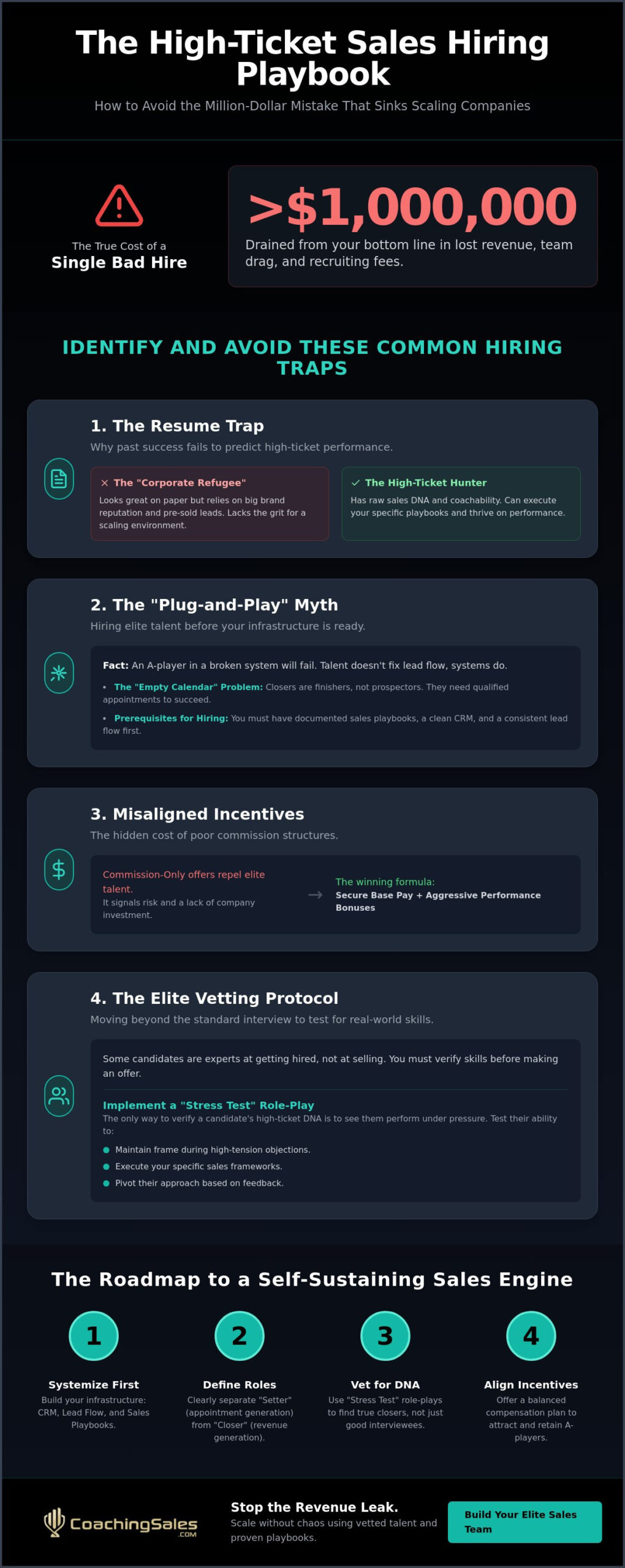
A single bad sales hire in 2026 can drain over $1 million from your bottom line once you factor in lost revenue and team productivity drag. It's a staggering figure, yet most founders continue to cycle through “closers” who look elite on paper but fail to convert high-ticket leads. You've likely felt the sting of stagnant revenue and the exhaustion of being trapped in a founder-led sales bottleneck. These common sales team hiring mistakes happen because talent alone isn't a strategy. If you're tired of burning cash on recruiting fees only to watch your conversion rates tank, it's time to change your approach.
You're about to stop the revenue leak by identifying the specific recruiting traps that sabotage high-growth companies. This guide provides the roadmap to move from operational involvement to true leadership by building a self-sustaining sales engine. We'll break down the “plug-and-play” myth, the reality of 2026 commission structures, and the elite vetting protocol you need to ensure your next hire is a long-term asset rather than a costly liability.
Key Takeaways
- Stop falling for the “Corporate Refugee” trap and learn how to identify the common sales team hiring mistakes that lead to expensive, low-performing turnover.
- Understand why your sales infrastructure must be optimized before you bring on a closer, or even an A-player will fail in your environment.
- Discover the ideal balance between base pay and performance incentives to attract elite closers who refuse to work on pure-risk, commission-only offers.
- Implement a “Stress Test” role-play in your vetting process to verify a candidate's high-ticket DNA before you commit to an offer.
- Transition from founder-led sales to a scalable engine by leveraging proven playbooks and vetted talent instead of relying on traditional, unspecialized recruiting firms.
The Resume Trap: Why Past Success Fails to Predict High-Ticket ROI
Resumes are historical documents. They tell you where a candidate has been, but they offer zero proof of what they'll do for your revenue next quarter. Falling for a polished pedigree is one of the most expensive sales team hiring mistakes you can make. In a high-ticket environment, the stakes are too high to rely on a list of past employers. You need to know if they can close your deals in today's market, not if they could ride the coattails of a massive brand five years ago.
Consider the “Corporate Refugee.” These candidates often come from household-name companies with unlimited resources and pre-sold leads. They weren't closing; they were taking orders. When you drop them into a scaling business without a massive support staff, they crumble. They lack the outbound grit required to build momentum. You're looking for a hunter, but you're often hiring someone who only knows how to eat at a buffet. In 2026, you must prioritize raw sales DNA and coachability over a ten-year pedigree that no longer applies to the modern marketplace.
Effective sales force management principles dictate that you hire for specific roles, not general talent. A “Setter” manages the front-end volume, while a “Closer” handles the high-pressure finish. If your hire can't distinguish between these functions, your pipeline will stall. Stop looking for a generalist and start looking for the specific psychological profile your current infrastructure requires.
The Danger of Overvaluing Industry Experience
Hiring an industry veteran is often a tactical error. They arrive with low-ticket habits and a resistance to new frameworks. An outsider with raw high-ticket DNA will consistently outperform a twenty-year veteran who refuses to adapt. You must test for “unlearning” during the recruitment process. If a candidate can't pivot their approach during a mock call, they'll be a liability on your real ones. Prioritize the ability to execute your specific Sales Playbooks over a decade of irrelevant experience.
Resumes vs. Real-Time Performance
Some people are world-class at getting hired but mediocre at actually selling. These “Interview Professionals” have mastered the art of the charm offensive. They look great on paper, but they lack the psychological fortitude to handle high-stakes resistance. Sales DNA is the ability to maintain frame during high-tension objections. Real-time performance testing is the only way to expose a lack of outbound grit before the first commission check is cut. Don't let a well-formatted PDF blind you to a lack of closing power.
The Plug-and-Play Myth: Hiring Closers Before Your Infrastructure is Ready
Many founders believe that hiring a “superstar” closer will magically solve their revenue stagnation. This is a dangerous delusion. One of the most frequent sales team hiring mistakes is attempting to plug high-level talent into a broken system. Talent doesn't fix lead flow; systems do. If your calendar is empty and your CRM is a mess, even the most elite closer will fail within weeks. A-players don't want to build your business from scratch; they want to execute a proven process that makes them money.
Infrastructure must come first. If you're still relying on founder-led sales where every deal is closed through sheer force of will and unwritten intuition, you aren't ready to hire. If you can't document it, you can't scale it. Researching a strategic way to hire reveals that the ecosystem is just as vital as the individual. You need clear, repeatable Sales Playbooks that dictate exactly how a lead moves from first touch to signed contract. Without these assets, you're just paying for someone else's expensive education at your company's expense.
Why Closers Can't Fix Broken Lead Generation
Elite talent thrives on volume. When you hire a high-ticket closer and hand them an empty calendar, you've already lost them. This “Empty Calendar” problem is the fastest way to demotivate a top performer. Closers are finishers, not prospectors. To see a real ROI, you need a distinct hand-off where a dedicated Sales Setter Program feeds the closer qualified appointments. Without this division of labor, your high-priced closer spends their day doing $20-an-hour admin work instead of $1,000-an-hour revenue generation. It's an inefficient use of capital that stalls growth.
The Minimum Viable Infrastructure for a New Hire
By 2026, the best sales professionals demand “Done-For-You” lead systems. They won't sign on if they have to “wing it” during the onboarding phase. Before you post a job description, ensure you have these essentials in place:
- Validated Sales Scripts: A proven framework that has already closed deals in your specific niche.
- Automated CRM: A system that tracks every touchpoint without manual data entry fatigue.
- Real-Time Dashboards: Absolute visibility into conversion rates, show rates, and pipeline health.
Winging it is a recipe for chaos. If your internal systems are disorganized, your new hires will churn, and you'll be back at square one with less cash in the bank. Avoid these common sales team hiring mistakes by building the machine before you hire the operator.
Misaligned Incentives: The Hidden Cost of Poor Commission Structures
Cheap talent is the most expensive thing you can buy. Many founders think they're being fiscally responsible by offering “commission-only” roles, but this is one of the most destructive sales team hiring mistakes in the high-ticket space. A-players don't gamble on your ability to provide lead flow. If you offer a pure-risk position, you'll only attract the desperate or the incompetent. Elite closers in 2026 demand a balanced structure that includes a competitive base and performance-based upside. They value your environment and lead quality as much as the commission percentage itself.
Retention is built on On-Target Earnings (OTE) and fair clawback provisions. If your incentive plan only rewards the first deal without considering long-term client success, you're training your team to be predatory rather than consultative. This misalignment creates a revolving door of talent. Addressing the challenges inherent in sales hiring means recognizing that your compensation plan is a direct reflection of your company's maturity. If you don't trust your own systems enough to provide a base salary, why should a top-tier closer trust you with their career?
Psychology of the High-Ticket Incentive
Desperate salespeople are a liability for premium brands. This is the “Hunger Paradox.” When a rep is worried about their next meal, they pressure prospects, ignore red flags, and destroy your brand equity just to hit a number. You want your team hungry for success, not hungry for survival. Structure your tiers to reward consistency. Use accelerators that kick in once they hit 100% of their quota. This keeps your best performers engaged and prevents the “whale hunting” mentality where reps coast after one big win. If you aren't sure where your current plan stands, you should audit your sales team performance immediately.
The True Cost of High Turnover
Every time a closer leaves, you pay a “hidden tax” that can reach 3-5 times their total compensation. This includes the cost of vacancy, retraining, and the momentum lost during the ramp-up period. A slightly higher base salary often leads to a lower overall Customer Acquisition Cost (CAC) because it stabilizes the team. Don't forget to incentivize your front-end talent too. Your Setter Program needs a structure that rewards lead quality over lead quantity. When the setter is financially tied to the closer's success, your entire pipeline becomes more efficient. Stop looking for ways to save on payroll and start looking for ways to maximize the ROI of every seat in your office.
The Elite Vetting Protocol: Moving Beyond the “Good Guy” Interview
Most interviews are a charm contest. Candidates show you their best self, and you hire based on a “gut feeling” or because they seem like a “good guy.” This subjective approach is one of the primary sales team hiring mistakes that leads to a 34% turnover rate in the industry. You don't need a friend; you need a high-performance operator who can maintain frame under pressure. To find them, you must replace conversational interviews with a rigorous, multi-step vetting protocol designed to break the candidate's mask.
Rigorous vetting starts with the “Stress Test” Role-Play. If a candidate can't handle a mock objection in a controlled environment, they'll fold on a live high-ticket call. Follow this with reference checks that actually matter. Stop talking to their peers or “friends.” Call their former managers and ask one specific question: “If you were starting a new company with your own money today, would this person be your first hire?” If the answer isn't a definitive yes, move on immediately. You're looking for proof of performance, not a list of people who like them.
Finally, assess coachability over raw competence. Give them a piece of direct, even harsh, feedback during the interview and tell them to redo a specific part of their role-play. If they get defensive or fail to apply the feedback, they're uncoachable. In 2026, the market shifts too fast for rigid talent. Hire in pairs during a trial period to isolate the variable. If both fail, your system is broken. If only one fails, you've identified the person as the problem. This A/B testing approach to hiring ensures you aren't guessing with your revenue.
Conducting a High-Stakes Sales Role-Play
Don't let the role-play be easy. Throw a “Hard No” objection early to see if they pivot or fold. You're testing for psychological resilience and the ability to stay in the pocket when things get uncomfortable. Watch their discovery depth. Are they asking “why” three layers deep, or are they rushing to the pitch? The discovery phase is the diagnostic stage where the sale is actually won or lost. If they skip the diagnosis, they aren't a closer; they're a presenter.
Identifying Cultural and Performance Alignment
High performance requires a specific rhythm. Test their willingness to join the “Daily Huddle.” If they view accountability as a burden, they won't last in a high-growth environment. In a decentralized, remote world, you also need to vet for extreme self-discipline. Ask for their specific daily routine and look for signs of a structured, results-oriented lifestyle. If you identify gaps in their approach during the trial, use professional Sales Coaching to see if they can bridge the gap or if they're a lost cause before you commit to a full-time contract.
Scaling Without Chaos: The Coaching Sales Recruiting Solution
Traditional recruiting firms are built for volume, not velocity. They operate as generalists, treating a high-ticket closer role the same as a middle-management desk job. This lack of specialization is why most external hiring efforts result in the same sales team hiring mistakes that keep you trapped in the weeds of your own business. For those in specialized niches like the RV industry, you can explore Flat-Fee Recruiting Services options to find a partner who understands your specific market dynamics. You don't need a recruiter who merely scans resumes for keywords; you need a partner who understands the psychological architecture of a high-stakes deal and provides the infrastructure to support it. If you want to scale to $10M+ without being chained to your calendar, a structured approach to remote sales team recruiting gives you access to a global talent pool of elite closers who are ready to perform from day one.
Coaching Sales eliminates the guesswork by providing a comprehensive revenue engine. We don't just find talent; we provide Sales Playbooks that turn new hires into revenue machines in days rather than months. By integrating a dedicated Setter Program, we ensure your closers spend their time on high-leverage activities instead of manual prospecting. This systematic approach transforms sales from a chaotic, personality-driven department into a predictable, scalable asset. If your goal is to move beyond founder-led sales, you must stop hiring individuals and start installing systems.
Plugging Vetted Talent Into Your Business
We source the top 1% of high-ticket talent through a rigorous, multi-stage vetting process that mirrors the elite protocol described earlier. This isn't just about finding someone who can talk; it's about finding someone who can perform under extreme tension. Our Done For You Sales Closers are battle-tested and ready to execute from day one. By utilizing performance-based placement, we align our success with your revenue growth. This eliminates the financial risk of traditional headhunter fees and ensures you only pay for results that move the needle.
Building Your Infrastructure for $10M+
Scaling to $10M and beyond requires a total transition from a founder-led model to a self-sustaining revenue engine. This evolution is impossible without ongoing Sales Coaching to maintain elite performance levels across your entire roster. Markets shift, objections evolve, and even A-players can develop bad habits over time. Consistent, high-level coaching keeps your team sharp and prevents the stagnation that typically follows rapid growth.
Stop settling for mediocre hires and broken lead flows. You've identified the traps; now it's time to deploy the solution. Build a team that wins without your constant intervention. Scale your high-ticket team with Coaching Sales and take back your time while your revenue hits new heights.
Build Your High-Performance Sales Engine Today
The margin for error in high-ticket sales has vanished. Continuing to repeat common sales team hiring mistakes isn't just an operational hurdle; it's a million-dollar drain on your bottom line. You now have the roadmap to move beyond vanity resumes and “gut-feeling” interviews. Success in 2026 requires a shift toward rigorous vetting, proven infrastructure, and incentives that align with long-term growth. If you're ready to step out of the founder-led bottleneck, you need a system that works without your constant supervision.
Coaching Sales provides that system. We've placed over 1,000+ high-ticket closers and specialize in scaling offers ranging from $3k to $50k+. We don't just provide talent; we deliver the Custom Sales Playbooks required for $10M+ scaling. Stop burning cash on unproven hires and start installing battle-tested operators who know how to win.
Scale your revenue with vetted high-ticket closers
Your transition from operator to leader starts with the right team. Take the first step toward a self-sustaining revenue engine today. It's time to dominate your market with absolute certainty.
Frequently Asked Questions
What is the biggest mistake when hiring a sales team?
Hiring for charm instead of proven infrastructure is the fatal error. Many founders look for a “unicorn” closer to fix a broken lead flow, but this is one of the most common sales team hiring mistakes. You must build the system first, then hire the operator. A-players won't fix your business; they'll only scale what already works.
Should I hire a sales closer or a sales setter first?
Hire a sales setter first to ensure your calendar is consistently full. A high-ticket closer is useless without qualified appointments to attend. By installing a setter first, you prove the lead generation model and create the volume necessary to attract a top-tier closer. This sequence prevents your most expensive hires from wasting time on low-leverage prospecting.
How much should I pay a high-ticket sales closer in 2026?
For high-ticket account executives, a 50/50 split between base salary and variable commission is the industry standard in 2026. Commission rates for B2B and SaaS typically range between 8% and 14% of the Annual Contract Value. Top performers expect tiered structures where exceeding quota increases their take-home significantly. Align your compensation with these market realities to attract elite talent.
Is it better to hire remote sales closers or in-house?
Remote is the dominant choice, with over 70% of sales roles offering hybrid or remote options in 2026. Remote hiring gives you access to a global talent pool rather than being limited by local geography. However, decentralized teams require stricter accountability systems and daily huddles to maintain momentum. Choose the model that matches your ability to manage performance through data. A proven framework for remote sales team recruiting ensures you source, vet, and integrate elite closers into an infrastructure that performs autonomously.
How do I know if my sales script is the reason my team is failing?
Your script is failing if your team consistently loses prospects during the transition from discovery to the pitch. If multiple hires struggle with the same objections, the problem is likely your framework. A high-performing script should act as a diagnostic tool that maintains frame. If your conversion rates are stagnant despite high call volume, it's time to audit your sales playbooks.
What are the red flags to watch for in a sales interview?
Resistance to real-time feedback is the ultimate red flag. If a candidate cannot pivot during a mock role-play, they are uncoachable and will become a liability. Watch for “Interview Professionals” who talk extensively about their past wins but ask zero discovery questions about your business. A true closer treats an interview like a sales call, leading with curiosity.
Can I hire commission-only sales closers for high-ticket offers?
You can hire commission-only reps, but you'll attract low-quality talent and increase your turnover risk. Elite high-ticket closers refuse pure-risk offers because they know their value. Desperate salespeople might accept, but they'll often pressure prospects and damage your brand reputation to survive. A balanced structure of base plus commission is necessary to secure the top 1% of performers.
How long should it take for a new sales hire to ramp up?
Expect a new hire to reach full productivity within 30 to 90 days. Companies with structured onboarding processes see a 70% improvement in new hire productivity, significantly shortening this window. Use the first 30 days to focus on product knowledge and script mastery. By day 90, they should be reaching full quota attainment and operating without constant supervision.