

Scaling to $10M isn't a matter of effort; it's a matter of architecture. Most founders are trapped in a cycle of hero selling because they lack a repeatable system. You've probably felt the sting of hiring a closer who promised the world but delivered an empty calendar. It's frustrating to have a world-class product and inconsistent revenue. If you're searching for what is high ticket sales, you aren't just looking for a dictionary definition. You're looking for the infrastructure that allows you to step back while your revenue steps up.
We agree that your time is too valuable to be spent on every discovery call. This blueprint provides the exact mechanics required to transition from founder-led selling to a high-performance team. You'll learn how to master the setter-closer dynamic and implement the playbooks necessary for elite revenue growth in 2026. By the end of this guide, you'll know how to build a predictable sales engine that delivers higher profit margins with fewer clients and zero hand-holding. It's time to stop guessing and start scaling.
Key Takeaways
- High-ticket sales are high-stakes transactions where the buyer's risk is significant, requiring a consultative approach to bridge the “Trust Gap.”
- Master the three pillars of the sales cycle, Education, Qualification, and Commitment, to navigate the complex approvals and longer timelines inherent in elite deals.
- Treat human capital as your primary revenue lever by recruiting A-players who possess the emotional intelligence and business acumen required for $10M+ scale.
- Understand that what is high ticket sales in 2026 is defined by a rigid infrastructure where elite talent and systems matter more than the product's price tag.
- Implement proprietary Sales Playbooks and a structured Setter Program to move from founder-led selling to a predictable, high-performance sales engine.
Defining High-Ticket Sales: Beyond the Price Tag
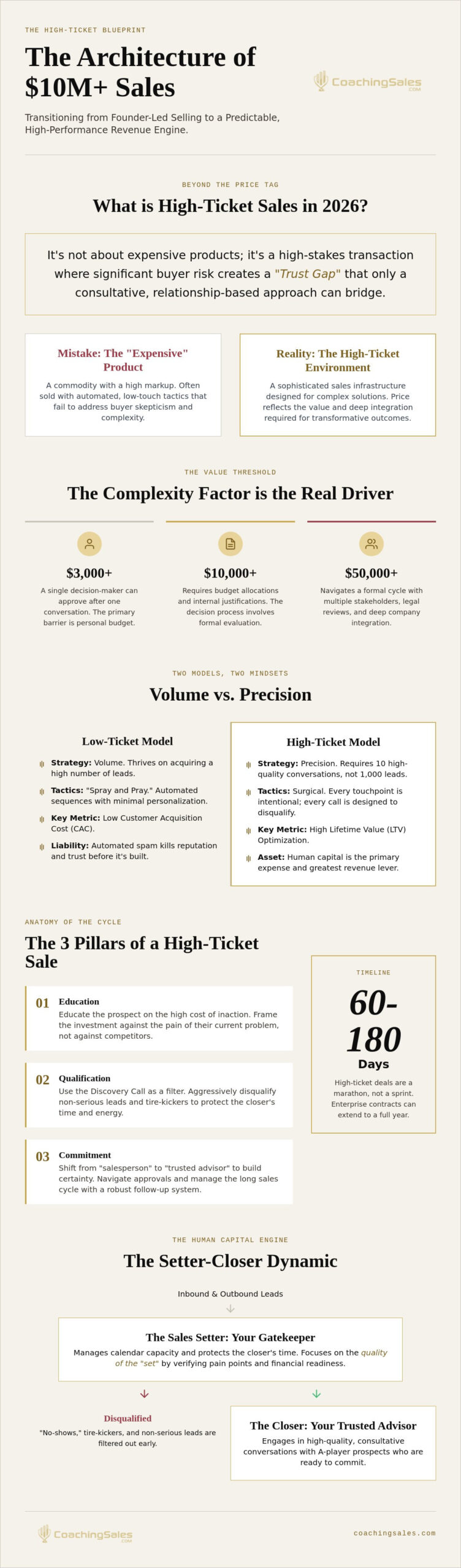
High-ticket sales isn't just about adding zeros to an invoice. It's a fundamental shift in business mechanics. If you're asking what is high ticket sales, you must look beyond the currency. These are high-stakes transactions where the buyer's risk is significant. It could be financial loss, professional reputation, or emotional burnout. This creates a “Trust Gap” that no automated email sequence can bridge. You can't close a $50,000 deal with a generic checkout page; you need a consultative selling methodology that prioritizes the relationship over the transaction.
Stop confusing “expensive” products with high-ticket environments. An expensive product is often just a commodity with a high markup. A high-ticket environment is a different beast entirely. It requires a sophisticated sales infrastructure designed to handle skepticism and complexity. High-ticket sales is a relationship-based model where the price reflects the complexity of the solution.
The Value Threshold: What Qualifies as High Ticket in 2026?
In 2026, the market is tiered by complexity. At the $3,000 level, a single decision-maker can usually pull the trigger after a single conversation. Once you hit $10,000, you're dealing with budget allocations and internal justifications. At $50,000 and above, you're navigating a formal evaluation cycle with multiple stakeholders. The “Complexity Factor” is the real driver here. If the purchase requires a change in company infrastructure or a multi-year commitment, it's high-ticket. This is why SaaS, elite consulting, and high-end service providers dominate this space. They don't just sell tools; they sell outcomes that require deep integration.
Low-Ticket vs. High-Ticket: Volume vs. Precision
Low-ticket models thrive on volume. They use “spray and pray” tactics because the cost of a lead is low and the risk is minimal. High-ticket models fail under that weight. You don't need 1,000 leads; you need 10 high-quality conversations with qualified prospects. The focus shifts from Customer Acquisition Cost (CAC) to Lifetime Value (LTV) optimization. Precision is the only way to maintain margins when human capital is your primary expense. When you understand what is high ticket sales at a deep level, you realize that automated spam is a liability. It kills your reputation before you even get a chance to build trust. Scaling requires a surgical approach to lead generation where every touchpoint is intentional and every conversation is designed to disqualify those who aren't a perfect fit.
The Anatomy of a High-Ticket Sales Cycle
High-ticket sales aren't a sprint. They're a calculated sequence of psychological milestones. When you're identifying what is high ticket sales in a practical sense, you're looking at a journey that prioritizes depth over speed. This cycle rests on three pillars: Education, Qualification, and Commitment. You don't just pitch a price; you educate the prospect on the cost of inaction. If they don't understand the value, the price will always feel too high.
The timeline is inherently longer than transactional models. While low-ticket items are impulse buys, high-ticket deals often span 60 to 180 days. Larger enterprise contracts can even stretch to a full year. This happens because you aren't just selling to one person. You're navigating multiple stakeholders, legal reviews, and budget approvals. Efficiency here requires a robust lead follow-up system. If you don't have a mechanism to catch prospects during these long windows, revenue leaks are inevitable. The Discovery Call acts as your primary filter. It's designed to disqualify non-serious leads before they ever touch your closer's calendar.
Lead Generation and the Role of the Sales Setter
The Setter is your gatekeeper. They manage calendar capacity and ensure only A-players reach the finish line. Unlike a traditional SDR who focuses on raw volume, a high-ticket setter focuses on the quality of the “set.” They use a specific appointment setting framework to verify pain points and financial readiness. This role is about protecting your most expensive asset: the closer's time. If your setters aren't elite, your closers will burn out on “no-show” calls and tire-kickers.
The Consultative Closing Process
Closing at this level requires a shift in identity. You aren't a salesperson; you're a trusted advisor. This transition is critical for aligning sales and marketing efforts toward a common goal. When a prospect raises objections about price or implementation risk, they aren't looking for a discount. They're looking for certainty. They need to know that your solution will actually solve their problem without creating new ones.
A rigid Sales Playbook ensures your team handles these high-level objections with consistency. It removes the guesswork and provides a proven roadmap for every conversation. If you want to see how elite teams structure these playbooks for $10M+ growth, you should look into how Coaching Sales builds sales infrastructure. Consistency is the only way to scale without constant hand-holding. You can't rely on “gut feeling” when millions in revenue are on the line.
The Human Capital: Why Talent is Your Greatest Revenue Lever
In high-ticket sales, the human is the product. When a prospect is considering a $25,000 investment, they aren't just buying your software or coaching; they're buying the certainty provided by the person on the other side of the screen. A “B-Player” doesn't just miss a sale. They incinerate your lead costs and damage your market reputation. Understanding what is high ticket sales requires a deep respect for human capital. Elite sales talent is an investment, not an expense.
The “A-Player” profile is rare. It requires a specific blend of high emotional intelligence, resilience, and sharp business acumen. These individuals don't just follow a script; they navigate complex psychological landscapes in real time. Traditional HR departments often fail here because they vet for resumes rather than raw performance traits. This is why founders are turning to specialized high ticket sales recruiting to find talent that is battle-tested in high-stakes environments. You need hunters who understand the nuances of the “Trust Gap” you've already identified.
Closers vs. Setters: Building a Balanced Team
Leverage comes from specialization. You shouldn't have your closers setting their own appointments. It's a waste of elite talent and a recipe for burnout. A high-performance engine uses setters to qualify leads and closers to finalize the commitment. If you're struggling to find this balance, the “Done For You” closer model allows you to plug vetted talent into a ready-made infrastructure. Managing commission-only teams requires a culture of extreme accountability. When your team's income is tied directly to performance, the culture becomes self-correcting. They don't need hand-holding; they need a calendar full of qualified prospects.
The Risk of the Wrong Hire
The true cost of a bad hire is astronomical. Beyond the wasted leads, you lose the most non-renewable resource: time. A single incompetent rep can burn through a month's worth of marketing budget before you even realize there's a problem. Vetting for traits like coachability and “internal locus of control” is more important than looking at a list of past employers. This is why choosing the right high ticket sales recruitment firm is a strategic decision for founders who want to scale past $10M. You aren't just hiring a rep; you're securing your revenue's future. Stop gambling on resumes and start investing in proven performance.
Building the Infrastructure for $10M+ Scale
Scaling to eight figures isn't a matter of effort. It's a matter of systems. When you've mastered what is high ticket sales at the individual level, the next hurdle is the infrastructure. You need a “Sales Ecosystem” where marketing, setting, closing, and fulfillment are perfectly integrated. If your marketing generates leads that your setters can't qualify, or your closers can't fulfill what was promised, the machine breaks. You must optimize your CRM to track the only KPIs that matter: Lead-to-Set ratios, Set-to-Close percentages, and total ROI. Data doesn't lie, but a lack of data will kill your growth.
Your Sales Playbook is the heartbeat of this infrastructure. It's a living document that ensures your process is repeatable and scalable. Without it, you're just hoping for the best. One of the first major decisions you'll face is choosing between outsourced sales vs in house teams. This choice dictates your overhead, your speed to market, and your management requirements. If you want to stop guessing and start growing, build your sales infrastructure with Coaching Sales.
Transitioning From Founder-Led Sales
Most businesses hit a ceiling known as the “Founder Trap.” This happens when you are the only one who can close high-level deals. Your business stops growing because your time is finite. You are the bottleneck. To break free, you must document your “magic” into a repeatable playbook. Step one is capturing your successful patterns. Step two is hiring your first setter to reclaim your calendar. Once you remove yourself from the discovery calls, you can finally focus on leading the engine rather than being a part in it.
Sales Coaching and Continuous Optimization
Even elite closers need high ticket sales coaching to stay at the top of their game. Think of your sales floor as a high-performance gym. Call reviews and roleplay sessions are the daily workouts that prevent performance plateaus. Use your data to identify revenue leaks in real-time. If your set-to-close ratio dips, you don't guess why. You dive into the recordings, identify the friction, and fix it immediately. High-ticket sales is a game of precision, and continuous optimization is the only way to win at scale.
Scaling Your High-Ticket Sales with Coaching Sales
Coaching Sales provides the “Done For You” infrastructure to stop the guesswork in scaling. We've spent years refining the mechanics of elite revenue growth so you don't have to. Our process is direct: we recruit elite talent, build your custom playbook, and train your team for peak performance. We focus exclusively on high-ticket environments because we know the stakes. We understand the specific psychology of the $10,000+ buyer and the precision required to close them consistently. If you truly understand what is high ticket sales, you know that a “generalist” approach will fail at this level. You need specialists who live in the world of elite revenue.
Our goal is to remove you from the day-to-day operations of your sales floor. You shouldn't be the one handling every objection or reviewing every lead. We build the engine so you can focus on leading the company. This isn't just about hiring a few reps; it's about installing a high-performance culture that operates with or without your direct involvement. We provide the roadmap to $10M+ while you reclaim your time.
Done-For-You Closers and Setters
Vetting talent is the most significant time-sink for any scaling founder. We solve this by identifying and recruiting the top 1% of sales professionals in the market. Our Done For You Sales Closers model provides plug-and-play revenue for your business. We don't just hand you a resume; we provide a professional who is battle-tested and ready to execute. Your new hires hit the ground running because we manage the world-class onboarding and initial training. This ensures they align with your brand voice and revenue goals from their first day on the calendar.
Custom Sales Playbooks and Infrastructure
A team without a playbook is just a group of individuals guessing. We build the “Source of Truth” for your sales department. This documentation ensures that every setter and closer follows a proven, repeatable process that you own. It allows you to scale human capital without the typical chaos of a growing business. When you have a clear infrastructure, you can finally step back from operational selling. You've learned what is high ticket sales and how the cycle works. Now, it's time to implement. Stop being the bottleneck in your own revenue growth. If you are ready to scale without the constant hand-holding, book a consultation with Coaching Sales today. Let's build your engine.
Master the Mechanics of Elite Revenue Growth
Scaling an elite business requires a decisive shift from operational involvement to strategic leadership. You've seen that what is high ticket sales in 2026 is defined by the strength of your infrastructure and the quality of your human capital. Success depends on transitioning from founder-led heroics to a predictable engine powered by specialized roles and rigid playbooks. If you continue to act as the primary closer, you remain the bottleneck in your own success.
It's time to install the systems that allow for $10M+ scale without the constant chaos. We specialize in building high-performance sales infrastructure through vetted A-Player recruiting and proprietary Sales Playbooks designed for elite teams. Stop guessing and start executing with a team that doesn't need constant hand-holding. Scale your high-ticket team with Coaching Sales and reclaim your capacity today. The roadmap is clear. Now, you just need to take the first step toward the pinnacle of your industry.
Frequently Asked Questions
What is a typical price point for high-ticket sales?
In 2026, high-ticket is generally defined as any offering priced above $3,000. While this is the baseline for many services, enterprise SaaS often considers $20,000 or more as the entry point for high-ticket complexity. These higher tiers require a more sophisticated sales infrastructure because the buyer's perceived risk increases alongside the price tag.
Can high-ticket sales be done remotely?
Absolutely. The majority of high-ticket sales in the coaching, consulting, and SaaS industries are now handled by remote sales closers. By using video conferencing platforms to build face-to-face trust, elite reps can close five and six-figure deals from anywhere in the world. This remote model allows founders to recruit the best talent regardless of geography.
What is the difference between a setter and a closer?
A setter, or SDR, acts as the gatekeeper who qualifies leads and manages calendar capacity. Their primary goal is to ensure only qualified prospects reach a call. A closer conducts the consultative deep-dive and secures the final commitment. When you understand what is high ticket sales at scale, you realize this division of labor is essential for protecting your closer's time.
How much commission do high-ticket closers make?
Commissions for high-ticket closers typically range from 10% to 20% of the total deal size. The specific rate often depends on whether the lead was generated through inbound marketing or outbound prospecting. Top-tier closers who operate in high-performance environments can earn significant monthly revenue by focusing on a small number of high-value commitments.
Is high-ticket sales harder than low-ticket?
It isn't harder, but it requires a different skill set. Low-ticket models rely on raw volume and automated sequences to drive transactions. In contrast, what is high ticket sales requires deep emotional intelligence, patience, and the ability to navigate complex implementation risks. You're selling a transformation and certainty, not just a product.
How long is a typical high-ticket sales cycle?
The length of the cycle depends on the price and complexity of the solution. A $3,000 offer might close in a single discovery call, but enterprise deals often stretch between 3 to 6 months. These longer cycles involve navigating multiple stakeholders and budget approvals, making a rigid follow-up system a non-negotiable requirement for success.